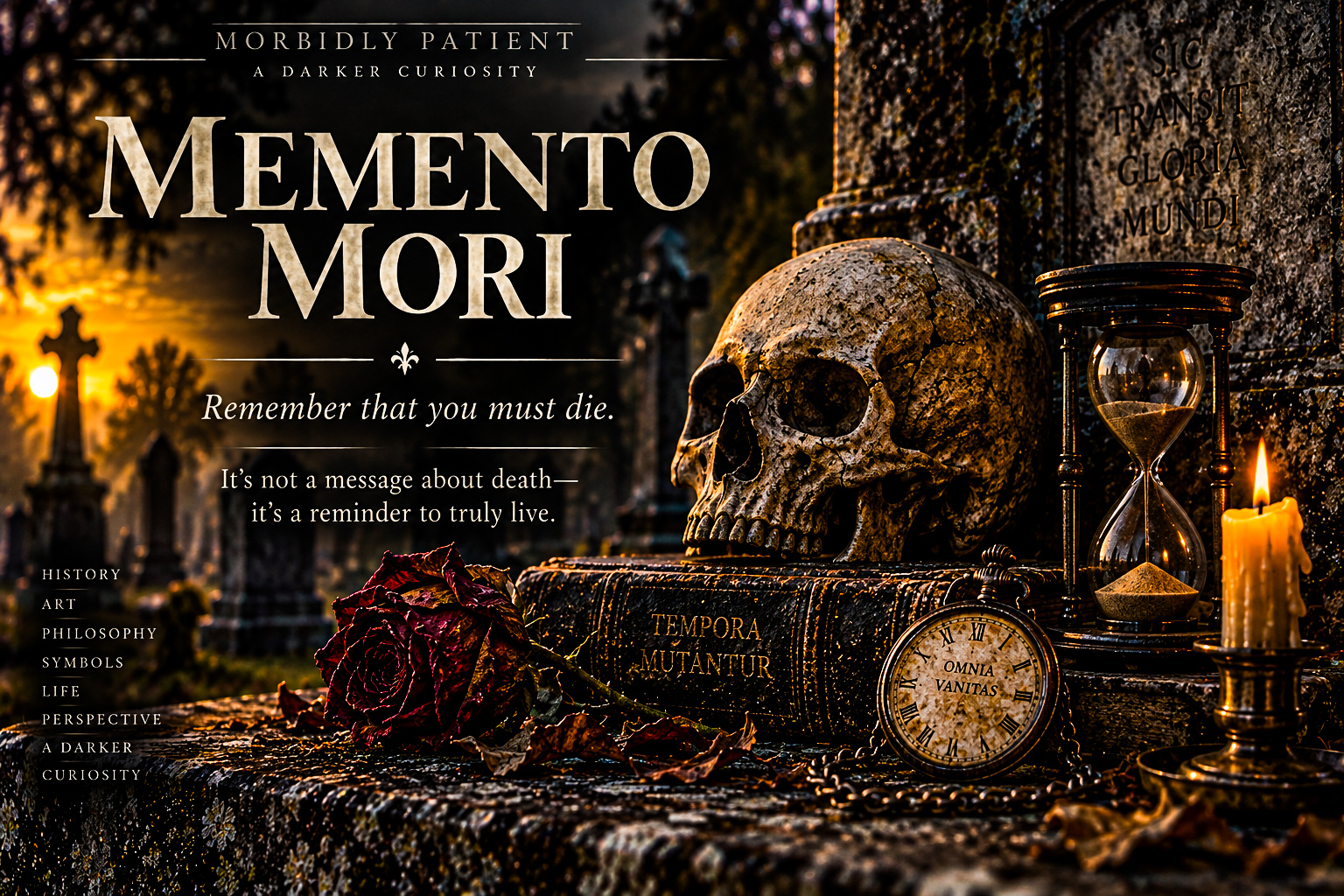
“Remember you must die” sounds grim. It may actually be one of the most useful reminders humans ever gave themselves.
There’s a skull sitting on the table.
Beside it is an hourglass.
A candle has burned almost to the bottom.
Flowers that were beautiful yesterday have begun to wilt.
Maybe there’s a watch.
A book.
A piece of fruit beginning to spoil.
Perhaps a mirror.
If you’re looking at an old painting, none of those things necessarily appeared there by accident.
They’re telling you something.
The skull is telling you.
The candle is telling you.
The flowers are telling you.
Even the little hourglass quietly running out of sand is telling you:
This ends.
So do you.
The idea has followed human beings through philosophy, religion, art, literature, cemeteries, jewelry and ritual for centuries.
We know it by a Latin phrase:
Memento mori.
Usually translated:
Remember that you must die.
Which admittedly isn’t going to sell many inspirational coffee mugs.
But maybe it should.
Because memento mori isn’t really an obsession with death.
It’s a reminder to pay attention to life.
What Does Memento Mori Actually Mean?
The Latin phrase memento mori is commonly translated as:
“Remember that you must die.”
Memento is an imperative—essentially, remember.
Mori relates to dying.
The phrase became associated with practices, objects and works of art intended to remind people of their mortality.
A skull on a desk could be a memento mori.
So could a painting.
A piece of jewelry.
A gravestone.
An hourglass.
A poem.
A skeleton carved into the wall of a church.
The object isn’t necessarily important.
The reminder is.
You are mortal.
Your time is limited.
Everything you possess will eventually belong to someone else, disappear, or cease to matter.
Everyone you love will die.
And eventually, so will you.
Cheerful little philosophy, isn’t it?
But stay with me.
This Idea Is Older Than the Latin Phrase
Human beings didn’t suddenly discover mortality when somebody put two Latin words together.
Awareness of death appears throughout ancient philosophy, religion and literature.
Ancient Greek and Roman thinkers regularly reflected upon mortality and the brevity of life.
The Stoic philosopher Seneca, for example, repeatedly wrote about the problem of wasting time—not because life is necessarily too short, but because human beings behave as though their supply of it were unlimited.
The Roman emperor and Stoic philosopher Marcus Aurelius repeatedly reminded himself that he and everyone around him would soon be gone.
Different traditions approached the problem differently.
But the underlying observation remained stubbornly consistent:
You’re going to die.
The question is what you’re going to do with that information.
Did Someone Really Whisper It to a Roman General?
You’ve probably heard the story.
A victorious Roman general rides through the streets during a triumph.
Crowds cheer.
He is surrounded by glory.
And standing behind him is a servant whose job is to whisper:
“Memento mori.”
Remember that you are mortal.
It’s a fantastic image.
It’s also one of those historical stories that becomes much cleaner in retelling than the surviving evidence allows.
Ancient sources do describe a person accompanying a triumphant commander and reminding him of his mortality or human status, but the familiar claim that a slave literally whispered the exact phrase “memento mori” into his ear is a later popular formulation rather than something we should confidently present as a documented Roman script.
That’s worth mentioning because Morbidly Patient has no reason to make history better than it already is.
The underlying idea is fascinating enough.
Imagine reaching the highest point of public glory available to you while somebody nearby essentially reminds you:
Enjoy this. You’re still going to die.
That’s memento mori in spirit, whether or not those exact two words were whispered.
Christianity Made Death Difficult to Ignore
Memento mori later became deeply embedded in medieval and early modern Christian culture.
Death wasn’t merely biological.
It carried theological consequences.
Life was temporary.
Judgment followed.
The condition of one’s soul mattered.
And reminders of death could therefore serve as reminders to repent, prepare and avoid becoming overly attached to earthly wealth or status.
Then medieval Europe encountered death on a scale difficult for us to imagine.
Disease.
War.
High infant mortality.
Childbirth.
Famine.
And, most famously, the Black Death of the fourteenth century.
Death wasn’t something safely tucked away in hospitals and funeral homes.
It was visible.
Personal.
Frequent.
And artists responded.
When Death Started Dancing
One of the most fascinating expressions of this preoccupation was the Danse Macabre—the Dance of Death.
In these images, skeletons or personifications of death accompany people from every level of society.
Kings.
Popes.
Merchants.
Peasants.
Children.
Nobody gets out of the dance.
That’s the point.
Your money doesn’t matter.
Your title doesn’t matter.
Your social rank doesn’t matter.
Death has remarkably poor respect for hierarchy.
There’s something almost subversive about these images.
The king and the beggar eventually arrive at the same destination.
Death is the great leveler.
Then Came the Skulls, Clocks and Rotten Fruit
By the sixteenth and seventeenth centuries, European artists developed increasingly elaborate visual languages around mortality.
This becomes particularly obvious in vanitas painting.
A beautifully rendered still life might contain luxurious objects:
Books.
Jewelry.
Musical instruments.
Flowers.
Fine fabrics.
Fruit.
Coins.
Then, sitting among them:
A skull.
An extinguished candle.
An hourglass.
A watch.
Rotting fruit.
Bubbles.
Objects suggesting that beauty, pleasure, wealth and knowledge are temporary.
You can accumulate everything.
You still don’t get to keep it.
The skull doesn’t ruin the painting.
The skull explains the painting.
Cemeteries Speak the Same Language
Once you learn the visual vocabulary of memento mori, old cemeteries begin talking.
Especially older ones.
You may encounter skulls.
Skulls with wings.
Crossbones.
Hourglasses.
Hourglasses with wings.
Extinguished torches.
Broken columns.
Urns.
Weeping willows.
Poppies.
Sleeping figures.
Different symbols emerged from different periods and traditions, and we should be cautious about assigning one universal meaning to every carving.
But collectively they demonstrate something we’ve become less comfortable doing publicly:
Looking directly at death.
Older gravestones could be surprisingly blunt.
Here lies a person.
They were alive.
Now they aren’t.
Eventually you won’t be either.
Have a pleasant afternoon.
Memento Mori Isn’t the Same as Being Morbid
This is where the phrase becomes particularly relevant to what we’re building here.
People sometimes assume that thinking about death must be pessimistic.
Why dwell on something unpleasant?
Why walk through cemeteries?
Why look at skulls?
Why talk about mortality?
Wouldn’t it be healthier to focus on life?
Perhaps.
But those ideas aren’t opposites.
You can think about death because you value life.
In fact, avoiding mortality entirely can create a peculiar illusion.
We know intellectually that life is finite.
But we frequently behave as though it isn’t.
We’ll take the trip later.
Call the person later.
Make the art later.
Write the book later.
Change careers later.
Spend time with our children later.
Say what needs saying later.
Live differently later.
There’s always another Monday.
Until eventually there isn’t.
Memento mori interrupts that illusion.
The Point Isn’t “You’re Going to Die”
You already know that.
The more useful question is:
What does knowing that change?
Suppose someone could tell you exactly how much time you had left.
Thirty years.
Ten.
Five.
Six months.
Would anything you’re currently worrying about suddenly become ridiculous?
Would anyone become more important?
Would something you’ve been postponing move to the top of the list?
Would you stop trying so hard to impress certain people?
Would you finally make something?
Go somewhere?
Say something?
Leave something?
That’s where memento mori stops being decorative skull imagery and becomes philosophy.
Mortality creates scarcity.
Scarcity creates value.
A sunset matters partly because it ends.
Childhood matters because it doesn’t last.
A conversation matters because there will eventually be a last one.
The ordinary Tuesday afternoon you’re barely noticing right now will someday belong to a category of things you can no longer have.
That’s uncomfortable.
It’s also true.
You Don’t Need to Know What Comes Next
For thousands of years, cultures have wrapped mortality in explanations.
Heavens.
Underworlds.
Reincarnation.
Resurrection.
Ancestor realms.
Spiritual continuance.
Oblivion.
Something.
Nothing.
Human beings have proposed answers to the question of what happens after death with tremendous confidence.
Memento mori requires none of them.
You don’t have to settle the afterlife before the idea becomes useful.
Whatever happens after death—or doesn’t happen—one fact remains remarkably difficult to argue with:
This particular life is happening now.
This morning happened once.
This year happens once.
This version of you exists once.
Whatever your metaphysics, the clock is still moving.
A Modern Memento Mori
You don’t need a human skull on your desk.
That tends to complicate conversations with visitors.
A memento mori can be almost anything that reminds you that your time is finite.
A cemetery photograph.
An old family picture.
A watch.
An antique object that belonged to someone who’s gone.
A dried flower.
A piece of jewelry.
A phrase written inside a notebook.
Even your own reflection in the mirror.
The goal isn’t to spend every morning thinking:
I’M GOING TO DIE.
That sounds exhausting.
The goal is occasionally remembering:
I’m not going to be here forever.
Those are different thoughts.
One creates dread.
The other can create perspective.
The Cemetery Is Full of Teachers
Spend enough time walking among old graves and you’ll encounter people who received exactly as much time as they received.
Some lived ninety years.
Some forty.
Some nine.
Some nine days.
You don’t know whether they expected more.
Probably many of them did.
Their stones don’t tell you whether they used their time wisely.
They don’t tell you whether they were happy.
They don’t tell you whether they spent twenty years worrying about something that never happened.
They don’t tell you what they regretted.
You usually get:
A name.
A beginning.
An ending.
And a dash between them.
Everything that mattered to that person happened somewhere inside that tiny mark.
Which means every cemetery contains essentially the same message written thousands of different ways:
You have a dash too.
You’re inside it right now.
Remember That You Must Die
Maybe that’s why memento mori has survived.
Not because humans enjoy being reminded of death.
Because we’re extraordinarily good at forgetting it.
We fill calendars.
Make plans.
Accumulate things.
Postpone things.
Argue about things that won’t matter in five years.
Live as though time were an automatically renewable resource.
And occasionally something interrupts us.
A skull in a painting.
An old gravestone.
An hourglass.
A funeral.
A birthday.
A gray hair.
A photograph of someone who isn’t here anymore.
For a moment, we remember.
This ends.
And perhaps the healthiest response isn’t despair.
Maybe it’s attention.
Look around.
Call someone.
Make something.
Go outside.
Learn something.
Stop postponing the life you’re supposedly preparing to live someday.
You don’t need to become obsessed with death.
Just remember it occasionally.
Because memento mori was never really about learning how to die.
It was about remembering that, for the moment,
you haven’t.
Morbidly Patient
A Darker Curiosity.
For those curious enough to look where others look away.
Leave a Reply