Why Humans Keep Reminding Themselves They’re Going to Die
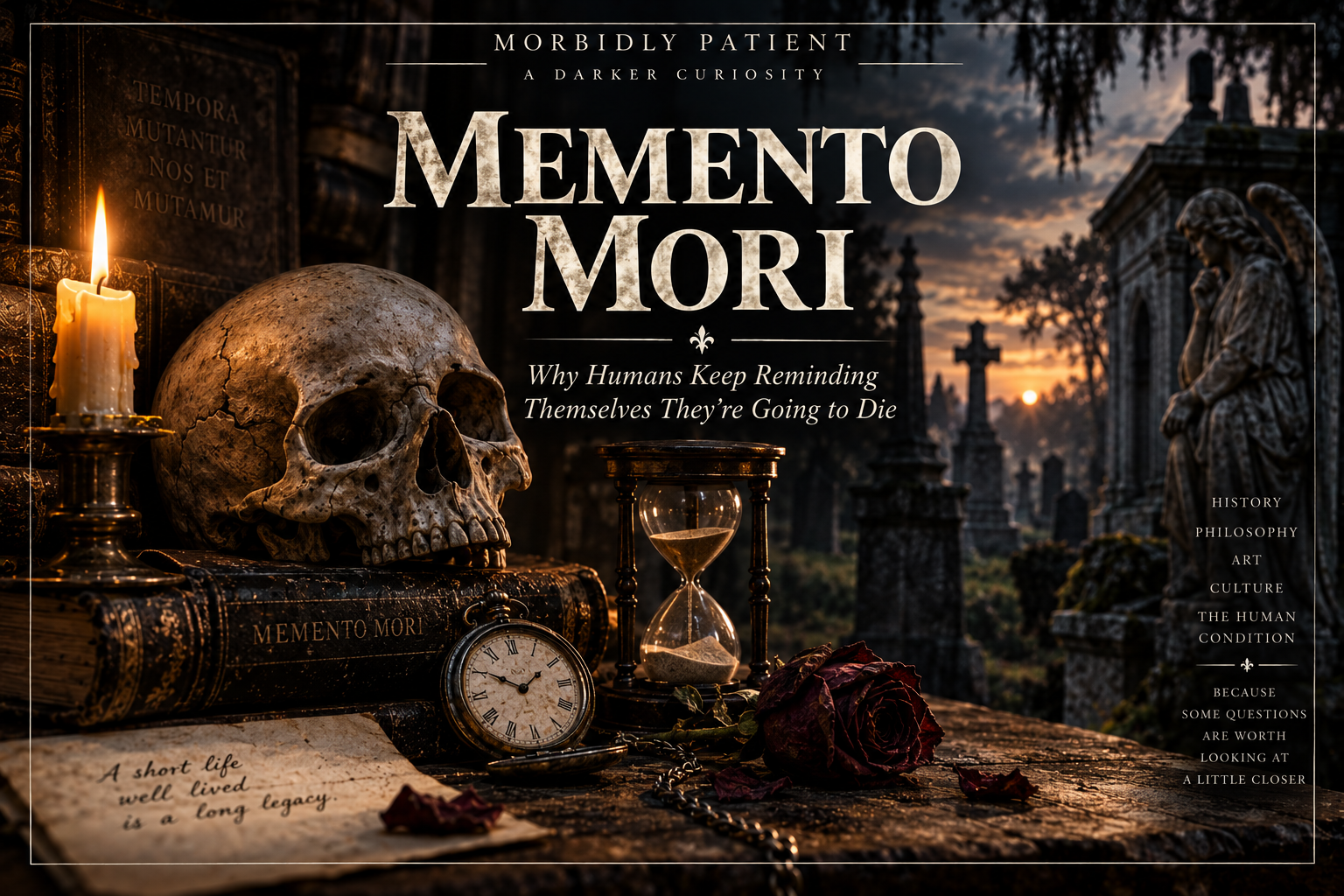
There is a skull sitting on the desk.
Not because someone died there.
Not because its owner is particularly interested in anatomy.
And not necessarily because they are trying very hard to look gothic.
The skull is there for the same reason someone once carved an hourglass onto a gravestone.
The same reason medieval artists painted skeletons dancing with kings.
The same reason seventeenth-century painters placed rotting fruit beside gold coins and beautiful flowers.
The same reason people wear little skulls around their necks, tattoo them onto their bodies, photograph old cemeteries, keep the ashes of people they loved on shelves, and occasionally stand in front of ancient graves reading the names of complete strangers.
The skull is there to say something.
You’re going to die.
Which raises an interesting question.
Why the hell would anyone want to be reminded of that?
Welcome to The Sunday Morbid.
Today we’re going to die.
Eventually.
No need to rush things.
We Spend an Extraordinary Amount of Energy Pretending This Isn’t Happening
There’s something peculiar about being human.
As far as we can tell, we possess enough self-awareness to understand that our existence is temporary.
We know people die.
We’ve watched it happen.
We’ve buried parents, spouses, children, friends and strangers.
We understand aging.
We understand disease.
We understand accidents.
We understand that eventually one of those gravestones will have our name on it.
And yet most mornings we wake up and behave as though this information doesn’t apply to us.
We make plans for next month.
Next year.
Retirement.
Someday.
We buy things intended to last thirty years.
We postpone trips.
Put off conversations.
Save books for later.
Wait for the right time to make art.
Stay in situations we dislike because eventually we’ll change them.
We say:
I’ll get around to it.
And most of the time, this psychological arrangement is probably useful.
You couldn’t function very well if every cup of coffee came with an existential crisis.
You have groceries to buy.
The lawn needs mowing.
Somebody has to remember the password to the electric company’s website.
Mortality can’t occupy the foreground every waking moment.
So we push it into the background.
But throughout history, humans have occasionally done something strange.
We’ve deliberately dragged it back out.
Remember That You Must Die
Memento mori.
Remember that you must die.
The phrase is Latin, but the idea is far older than the phrase itself.
Human beings have been thinking about the brevity of life for as long as we have evidence of humans thinking deeply about much of anything.
Ancient philosophers wrestled with mortality.
Religious traditions built rituals around it.
Poets wrote about it.
Artists painted it.
And eventually those two Latin words became shorthand for an entire tradition of deliberately confronting death.
Not avoiding it.
Not defeating it.
Looking at it.
A skull could do the job.
So could an hourglass.
A dying flower.
An extinguished candle.
A cemetery.
The object itself wasn’t really the point.
The interruption was.
For a moment, whatever trivial nonsense had convinced you it was the most important thing in the universe had to compete with one uncomfortable fact:
Your clock is running.
The Romans Had the Same Problem We Do
One of the most repeated stories about memento mori involves the Roman triumph.
A victorious commander returns to Rome.
Crowds cheer.
He rides through the city surrounded by symbols of victory.
For a brief moment, he’s about as close to a god as a mortal Roman could feel.
And somewhere in this story is another person reminding him:
You’re still mortal.
The popular modern version has a slave standing behind the victorious general whispering the literal words memento mori into his ear.
The history is less tidy.
Ancient accounts do contain the idea of someone accompanying the triumphant commander and reminding him of his human condition, but the familiar image of a slave repeatedly whispering those exact Latin words is a later simplification.
Which is fine.
We don’t need to improve the story.
The underlying idea is better anyway.
Imagine experiencing perhaps the greatest moment of your life.
Thousands of people shouting your name.
Victory.
Power.
Status.
And right in the middle of it:
Don’t get carried away.
You’re temporary too.
That’s brutal.
And perhaps necessary.
Then Death Started Dancing
Medieval Europe wasn’t exactly lacking reminders of mortality.
Disease.
War.
Famine.
Childbirth.
Infant mortality.
Injury.
And then the Black Death tore through Europe in the fourteenth century, killing on a scale that transformed communities and culture.
Death wasn’t hidden in a hospital room somewhere across town.
It lived nearby.
You knew it.
You smelled it.
You watched it enter houses.
You watched people disappear.
And eventually death began appearing in art in a wonderfully disturbing form.
The Danse Macabre.
The Dance of Death.
Kings danced with skeletons.
So did clergy.
Merchants.
Laborers.
Women.
Men.
Children.
Rich people.
Poor people.
Death moved through society collecting everybody.
The message wasn’t particularly subtle:
Your social status does not impress the skeleton.
Death was the ultimate social equalizer.
You might own a castle.
Someone else might sleep on the floor.
Eventually both of you became remarkably similar archaeological material.
There’s something almost rebellious about that imagery.
The king may stand above the peasant in life.
The grave has no throne.
The Skull Eventually Moved Into the Living Room
Then artists became considerably more sophisticated about ruining everyone’s mood.
Enter the vanitas still life.
At first glance, many of these paintings are beautiful.
Flowers.
Fruit.
Jewelry.
Coins.
Books.
Musical instruments.
Fine fabrics.
Objects displaying wealth, learning, pleasure and accomplishment.
And then you notice the skull.
Or the hourglass.
Or the candle that has just gone out.
Or fruit beginning to rot.
The painting changes.
Those objects aren’t simply there because the artist was good at painting expensive things.
They’re temporary.
The flower wilts.
The fruit decays.
The candle burns down.
The money eventually belongs to somebody else.
The music stops.
The book closes.
And the person looking at the painting eventually becomes exactly as dead as the skull.
Vanitas takes its name from the biblical language of vanity, particularly the idea that earthly pursuits are fleeting.
But you don’t need the theology to understand the painting.
You can stand in front of one centuries later with no religious belief whatsoever and still get the message.
Everything you’re looking at disappears.
Including the person looking.
We Put the Same Message in Cemeteries
Walk through an old burial ground and eventually the dead begin reminding you that you’re joining them.
Especially in older funerary art.
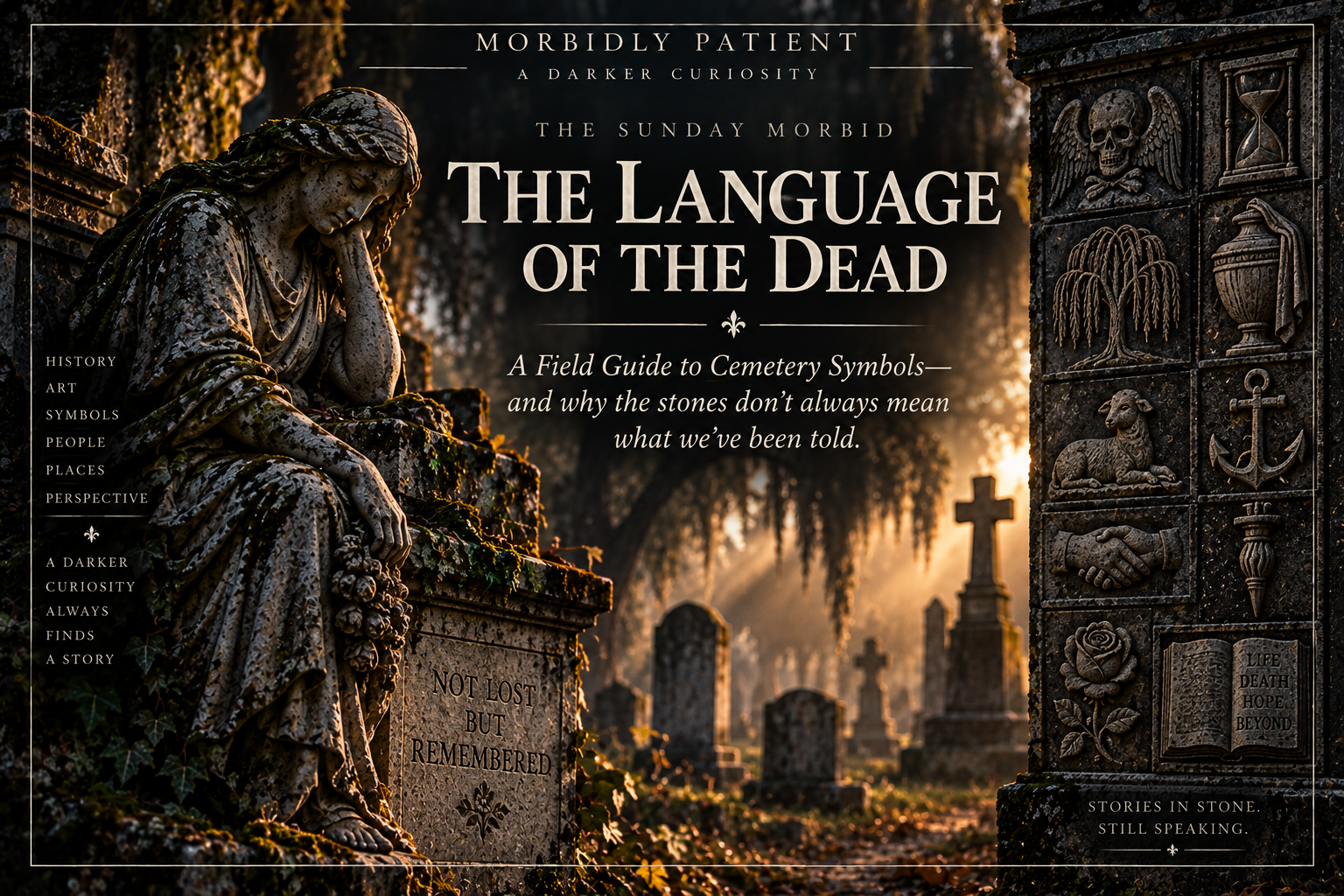
Winged skulls.
Crossbones.
Hourglasses.
Skeletons.
Extinguished torches.
Broken columns.
Poppies.
Urns.
Some symbols promise resurrection.
Some communicate mourning.
Some speak about sleep.
Some represent religious hope.
But beneath much of the visual vocabulary lies the same uncomfortable reality:
Life ends.
Old gravestones could be remarkably comfortable saying this directly.
You occasionally encounter epitaphs that essentially address the passerby:
You are what I once was.
I am what you will become.
That’s an interesting thing to carve into a rock beside a public walking path.
Imagine putting the modern equivalent beside the entrance to Walmart.
WELCOME.
EVERYONE ENTERING THIS BUILDING WILL EVENTUALLY DIE.
ROLLBACK PRICES IN AISLE 7.
We’ve changed.
We Got Better at Hiding Death
For much of human history, death happened at home.
Bodies were washed and prepared by families and communities.
People sat with the dead.
Children saw dead relatives.
Funeral rituals happened close to ordinary life.
Cemeteries might surround the church people visited every week.
You didn’t necessarily have the luxury of imagining death as something that happened somewhere else.
Modern industrialized societies changed much of that.
Hospitals became more involved in dying.
Funeral professionals assumed responsibilities families once performed themselves.
Bodies disappeared behind institutional doors.
Cemeteries moved away from dense residential centers.
Death became increasingly professionalized.
That’s not inherently bad.
Modern medicine, sanitation, professional funeral care and hospice have brought enormous benefits.
But something else happened along the way.
Death became easier not to look at.
We became extraordinarily good at consuming fictional death while avoiding actual mortality.
We’ll watch fifty people die during a television series.
Then become uncomfortable when someone says:
I’m going to die someday.
Well.
Yes.
That’s how this works.
Maybe That’s Why the Skull Keeps Coming Back
Skulls never really disappear from culture.
They just change wardrobes.
Pirate flags.
Military insignia.
Goth fashion.
Heavy metal.
Motorcycle culture.
Tattoos.
Jewelry.
Halloween decorations.
Fine art.
Fashion.
Cemetery photography.
Skulls can mean danger.
Rebellion.
Mortality.
Poison.
Death.
Defiance.
Sometimes they’re simply aesthetically appealing.
But underneath all of those interpretations is something remarkable.
The human skull is simultaneously us and not us.
Look at one long enough.
That’s what’s underneath your face.
Not metaphorically.
Right now.
Your eyes, hair, expressions, wrinkles, smile and everything people recognize as you are wrapped around essentially the same architecture sitting underneath everyone else’s face.
Strip enough away and status disappears again.
CEO.
Machinist.
Pastor.
Artist.
Politician.
Billionaire.
Nobody’s skull wears a Rolex.
That’s probably why the image has remained powerful for so long.
Some People Keep Death on Their Desks
There are still people who deliberately keep memento mori objects nearby.
Skulls.
Hourglasses.
Coins.
Artwork.
Jewelry.
Photographs.
Old objects belonging to people who died.
Not because they’re necessarily depressed.
Not because they want to die.
Because they don’t.
That’s the part outsiders sometimes misunderstand about morbid curiosity.
Thinking about death doesn’t necessarily mean wishing for it.
Sometimes it’s exactly the opposite.
Mortality gives life edges.
Without an ending, urgency disappears.
Suppose you had an infinite number of Saturdays.
Why would this Saturday matter?
You could always visit your mother next Saturday.
Take the trip next year.
Write the book in fifty years.
Tell someone you love them eventually.
Watch the sunrise another century.
There would always be more.
But there isn’t.
Scarcity creates value.
We understand that with almost everything except time.
Imagine Knowing Your Number
Here’s an uncomfortable experiment.
Suppose I could tell you exactly when you’re going to die.
Not how.
Just when.
And suppose the date were absolutely certain.
September 20, 2056.
Thirty years.
What changes?
Probably not everything.
You’d still need groceries.
Bills would remain irritating.
Your back would probably still hurt occasionally.
But thirty years would become a measurable resource.
Now shorten it.
September 20, 2036.
Ten years.
Does anything move up the list?
Now:
September 20, 2027.
One year.
Suddenly the meeting you’re dreading next Tuesday seems less important.
Someone you’ve been meaning to call becomes more important.
The place you’ve always wanted to see changes categories from someday to possibly never.
Now make it one month.
The entire architecture of importance collapses and rebuilds itself.
Most of the things consuming your attention today wouldn’t survive the demolition.
That’s what memento mori is trying to accomplish without requiring a terminal diagnosis.
The Problem Isn’t That We Forget Death
We don’t.
Not really.
We know.
The problem is that we behave as though we don’t.
We say we’re too busy to do things that matter while spending hours doing things that don’t.
We postpone joy because we haven’t earned it yet.
We keep possessions for occasions that never arrive.
We stay angry at people long after we’ve forgotten exactly why.
We avoid difficult conversations because there will be a better time.
We wait until children are older.
Until work settles down.
Until finances improve.
Until the house is finished.
Until retirement.
Until Monday.
Until January.
Until someday.
Someday is an extraordinarily dangerous place to store your life.
Because someday isn’t on the calendar.
But Memento Mori Can Go Wrong Too
There’s another side worth acknowledging.
Thinking about mortality doesn’t automatically make someone wise.
You can turn memento mori into another aesthetic.
Buy the shirt.
Get the tattoo.
Put a skull on the shelf.
Post a quote about living every day as though it’s your last.
Then spend three hours arguing with a stranger online.
Humans are talented like that.
And constant preoccupation with death isn’t necessarily helpful either.
If mortality becomes so loud that it prevents you from participating in life, we’ve missed the point.
Memento mori isn’t supposed to make every breakfast feel like a funeral.
It’s a calibration tool.
A reminder occasionally brought out when our sense of importance gets distorted.
Is this worth part of my finite life?
That’s a useful question.
Sometimes the answer is yes.
Sometimes you’ll realize you’ve spent forty-five minutes arguing about how somebody loaded the dishwasher.
Cemeteries Do This Without Saying Anything
This may be one reason I find cemeteries so compelling.
They don’t have to preach.
Walk through one slowly.
Look at the dates.
1928–2021.
Long life.
Next stone:
1974–2019.
Shorter.
Then:
2006–2008.
Two years.
Maybe eighteen months.
Maybe eighteen days.
The cemetery refuses to maintain our comforting assumption that everybody gets approximately eighty years.
They don’t.
Never have.
Somebody beneath those stones probably had plans for the following week.
Somebody had clothes hanging in a closet.
Food in a refrigerator.
A book with a bookmark halfway through.
An appointment written on a calendar.
Maybe an argument they expected to finish later.
Then there was no later.
That’s not supernatural.
That’s not pessimistic.
It’s simply the price of admission for being alive.
The Gravestone Is a Memento Mori Even Without the Skull
A gravestone contains one of the most economical representations of a human life we’ve ever invented.
A name.
A date.
A dash.
Another date.
1951–2026
There it is.
Seventy-five years compressed into punctuation.
Everything happened inside that dash.
First steps.
School.
Sex.
Heartbreak.
Jobs.
Children.
Arguments.
Christmas mornings.
Hospital rooms.
Bad decisions.
Inside jokes.
Vacations.
Ordinary Tuesdays.
People loved.
People lost.
Thousands of breakfasts.
Millions of thoughts nobody else ever heard.
Then the second date.
We focus on the numbers.
Maybe the dash deserves more attention.
Because you’re currently inside yours.
Nobody Knows What Happens After the Second Date
This is where things get particularly interesting.
Human beings have spent thousands of years answering the question.
What happens next?
Heaven.
Hell.
Resurrection.
Reincarnation.
Ancestor worlds.
Spiritual realms.
Return to nature.
Consciousness continuing somehow.
Oblivion.
Nothing.
Something we haven’t imagined.
People have killed one another over competing answers.
Built religions around them.
Written books.
Constructed temples.
Had visions.
Reported experiences.
Created rituals.
Argued endlessly.
And after all of that certainty, we’re still standing beside the same grave.
Maybe you believe you know.
Maybe you strongly suspect.
Maybe you don’t know at all.
Memento mori doesn’t require us to solve it.
Whatever waits beyond death, if anything, doesn’t change one immediate fact:
You’re here now.
This morning existed.
Tomorrow might.
That’s enough information to work with.
Maybe Morbid Curiosity Isn’t So Morbid
That’s ultimately why something like Morbidly Patient exists.
Not because death is the only interesting subject.
Quite the opposite.
Death touches almost every interesting subject.
History.
Religion.
Art.
Medicine.
Architecture.
Archaeology.
Philosophy.
Folklore.
Family.
Love.
Fear.
Identity.
Culture.
Memory.
What we do with bodies tells us what societies believe.
What we carve on gravestones tells us what people wanted remembered.
What we fear about death tells us something about what we value in life.
And what we imagine happens afterward may tell us even more.
Morbid curiosity is often curiosity about being human with the polite curtain pulled back.
That’s all.
We’re looking.
Keep the Skull
So maybe put a skull on your desk.
Or don’t.
Carry an old coin.
Photograph gravestones.
Keep your grandfather’s watch.
Wear a memento mori ring.
Walk through an old cemetery occasionally.
Look at the names.
Look at the dates.
Remember the people underneath them weren’t always dead.
Once they were standing where you are.
They had things to do.
Places to be.
People waiting for them.
They probably worried about money.
Got irritated in traffic.
Fell in love.
Made mistakes.
Thought they had more time.
Then eventually someone carved the second date.
One day somebody will carve ours.
Or scatter us.
Compost us.
Dissolve us.
Keep us in an urn.
Plant a tree over us.
Or do whatever strange new thing humans invent for dead bodies between now and then. Contemporary death care already includes green burial, alkaline hydrolysis, and natural organic reduction alongside burial and flame cremation.
None of that is particularly frightening to me.
What’s more unsettling is the possibility of reaching that second date having spent too much of the dash waiting for permission to live.
Maybe that’s why humans keep making reminders of death.
Not because we’ve forgotten we’re going to die.
Because we keep forgetting we’re currently alive.
The skull isn’t saying:
Give up.
The hourglass isn’t saying:
Be afraid.
The cemetery isn’t saying:
Nothing matters.
They’re saying something much more inconvenient.
This matters because it ends.
So remember that you must die.
And then, having remembered,
go do something with the fact that you haven’t yet.
Morbidly Patient
A Darker Curiosity.
For those curious enough to look where others look away.