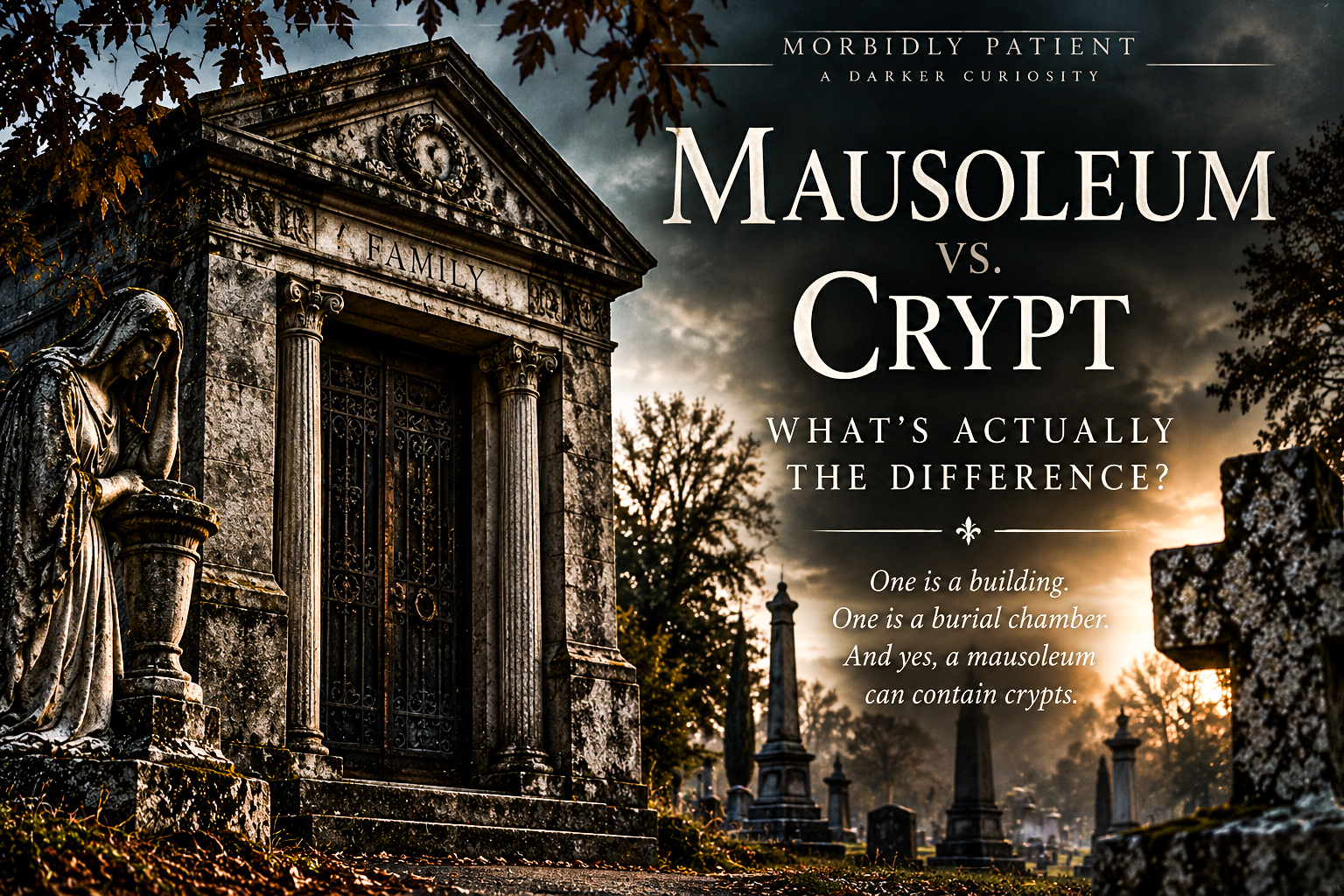
One is a building. One is a burial chamber. And yes, a mausoleum can contain crypts.
Walk through an older cemetery long enough and eventually you’ll encounter one.
A little stone building sitting among the graves.
Maybe it has heavy bronze doors.
Maybe there are stained-glass windows.
Maybe a family name is carved prominently above the entrance.
Maybe you can peer through the doors and see something inside.
And there’s a good chance someone walking beside you will say:
“That’s a crypt.”
Maybe.
But probably not.
The building itself is usually a mausoleum.
The crypt is something else.
The two words are closely related because they often describe parts of the same burial arrangement, but they aren’t interchangeable.
Fortunately, the difference is considerably easier to understand than some cemetery terminology.
A mausoleum is a structure.
A crypt is a chamber or space used to hold human remains.
And the story behind those two words takes us from one extraordinarily elaborate ancient tomb to churches, cemeteries, underground chambers and the little stone buildings we still construct for our dead.
The Short Answer
Let’s make this easy before we wander down the historical rabbit hole.
A mausoleum is a building or above-ground structure constructed to contain human remains.
A crypt is an individual burial chamber, compartment or enclosed space where a body or remains are placed.
Therefore:
A mausoleum can contain one crypt.
It can contain several crypts.
A large community mausoleum can contain hundreds or even thousands of them.
But a crypt doesn’t necessarily have to be inside what we’d normally call a mausoleum.
Crypts can also exist beneath churches and other structures.
Think of it this way:
The mausoleum is the structure.
The crypt is where the dead person actually goes.
Now that we’ve solved the practical problem, naturally we’re going to make things more interesting.
Mausoleum: A Man Became a Word
Unlike graveyard, which is about as literal as words get, mausoleum has a much better origin story.
It comes from a person’s name.
Mausolus.
Mausolus was a ruler of Caria in the fourth century BCE in what is now southwestern Turkey.
After his death around 353 BCE, an enormous monumental tomb was constructed for him at Halicarnassus.
Calling it a tomb almost undersells the thing.
The Mausoleum at Halicarnassus became one of the Seven Wonders of the Ancient World.
Ancient descriptions and archaeological evidence indicate an enormous elevated structure decorated with extensive sculpture and crowned by a stepped roof and sculptural elements.
It was intended to do considerably more than simply keep Mausolus’ remains out of the rain.
It was architecture saying:
This person mattered.
And apparently it worked.
Most of us couldn’t tell you much about Mausolus.
But more than two thousand years later, we still use a version of his name every time we call a monumental burial structure a mausoleum.
That’s a fairly impressive afterlife for a name.
Eventually mausoleum stopped referring only to the Mausoleum and became a general term for monumental structures containing tombs or burial chambers.
Which brings us back to those little stone buildings in our cemeteries.
So What’s Inside a Mausoleum?
That depends on the mausoleum.
Some are built for a single person.
Others hold a married couple.
Some contain generations of one family.
Large community mausoleums may contain the remains of hundreds or thousands of unrelated people.
Inside you’ll generally find spaces designed to receive the dead.
Those spaces are crypts.
A casket may be placed into a crypt, which is then sealed and usually faced with stone, marble, granite or another material.
The front may carry much the same information we’d expect to find on a headstone:
A name.
Birth date.
Death date.
An inscription.
Religious imagery.
Sometimes photographs or decorative elements.
The fundamental idea isn’t terribly different from burial in the ground.
We’ve simply changed the architecture.
Instead of:
body → casket → grave → earth
we have something more like:
body → casket → crypt → mausoleum
One puts the dead beneath the landscape.
The other incorporates them into a structure.
But Crypts Can Be Underground
This is where the terminology becomes more interesting.
Say the word crypt and many of us immediately imagine something beneath an ancient church.
Stone stairs descending into darkness.
Arched ceilings.
Dust.
Candles.
Perhaps a skeleton for atmosphere.
And historically, that association makes sense.
The word ultimately comes from Greek language associated with something hidden or concealed.
Crypts developed particularly strong associations with chambers beneath churches.
Early Christian churches sometimes incorporated spaces associated with saints, martyrs, relics or burials beneath or near important areas of the building.
Over time, underground church crypts became burial places for clergy, nobles and other significant individuals in various places.
So:
A crypt does not have to be inside a freestanding mausoleum.
It may be underneath a church.
It may be incorporated into another building.
It may even be part of a structure largely below ground.
The defining feature isn’t really whether you can see it from outside.
It’s the burial chamber itself.
Then What’s a Tomb?
Now we’ve opened another door.
A tomb is the broader term.
A tomb is a structure, chamber or enclosed place containing human remains.
That means both mausoleums and crypts can fall within the larger world of tombs.
The pyramids?
Tombs.
Elaborate rock-cut burial chambers?
Tombs.
A sarcophagus inside a monumental structure?
Part of a tomb arrangement.
The word is broad enough that trying to make every burial structure fit into one perfectly clean taxonomy becomes difficult very quickly.
Humans have been constructing places for dead people for thousands of years.
We were not thinking about whether twenty-first-century cemetery enthusiasts would find our terminology convenient.
Inconsiderate, really.
And What About a Sarcophagus?
A sarcophagus is different again.
It’s essentially a stone coffin or coffin-like container.
The word has a particularly wonderful—and slightly horrifying—history.
It comes through Greek and Latin from words associated with “flesh-eating” stone.
Certain limestone was believed to help consume or decompose the flesh of bodies placed within it.
Hence:
sarko — flesh
phagein — to eat
A flesh eater.
Language is occasionally delightful.
A sarcophagus can be placed inside a tomb.
A tomb can be inside a mausoleum.
And a mausoleum can contain crypts.
Which means you can potentially encounter several correct burial terms while standing in front of one structure.
Welcome to cemetery terminology.
Private Mausoleums vs. Community Mausoleums
Most of the picturesque structures photographers gravitate toward are private mausoleums.
These were often constructed for wealthy individuals or families.
Family names may be carved prominently across the façade.
Architectural styles vary tremendously.
Classical columns.
Gothic arches.
Egyptian Revival motifs.
Romanesque stonework.
Art Deco.
Stained glass.
Bronze doors.
Religious sculpture.
Sometimes the architecture tells you nearly as much about the period and family as the inscriptions do.
But mausoleums aren’t exclusively private monuments.
Community mausoleums contain crypts for many individuals or families within one larger building.
Some modern cemeteries have enormous indoor mausoleum complexes with corridors lined by crypt fronts.
There are also garden or outdoor mausoleum arrangements, where crypts are accessed from exterior walls rather than interior hallways.
Same basic concept.
Different architecture.
Mausoleums Tell Us Something About the Living
This is where cemetery terminology becomes more than vocabulary.
Why build a house for a dead person?
Practically speaking, there are reasons.
Land conditions.
Family preferences.
Religious traditions.
Available cemetery space.
The desire to keep family members together.
But throughout history, mausoleums have also communicated something else.
Status.
Walk through an old cemetery and architecture becomes social history.
A small unmarked stone tells one story.
A modest family plot tells another.
A towering granite monument tells another.
And a private stone building with bronze doors and stained glass makes a statement difficult to miss.
Someone had the resources to build this.
Someone wanted permanence.
Someone expected the family name to remain visible.
And perhaps someone couldn’t tolerate the thought of the person simply disappearing beneath the ground.
There’s something wonderfully human about that.
We know stone eventually fails.
Names weather away.
Families die out.
Buildings collapse.
Even the Mausoleum at Halicarnassus didn’t survive intact.
And yet we build.
We carve.
We seal names into granite.
We construct little houses for people who no longer need shelter.
Perhaps that’s part of what cemeteries really are.
Architecture built against forgetting.
So, Mausoleum or Crypt?
The next time you’re wandering through a cemetery and encounter one of those stone structures, here’s your simple field guide:
MAUSOLEUM
The building or above-ground burial structure.
CRYPT
The chamber or compartment where human remains are placed.
TOMB
A broader term for a structure or enclosed place containing the dead.
SARCOPHAGUS
A stone coffin or coffin-like container for human remains.
And if you want one sentence to remember everything:
You can put a sarcophagus in a tomb, crypts inside a mausoleum, and a mausoleum itself is a type of monumental tomb.
Cemetery vocabulary solved.
Mostly.
Because we haven’t even gotten to columbaria, ossuaries, catacombs, cenotaphs, vaults and niches yet.
We will.
We’re Morbidly Patient.
There are plenty of dead words left to dig up.
Morbidly Patient
A Darker Curiosity.
For those curious enough to look where others look away.