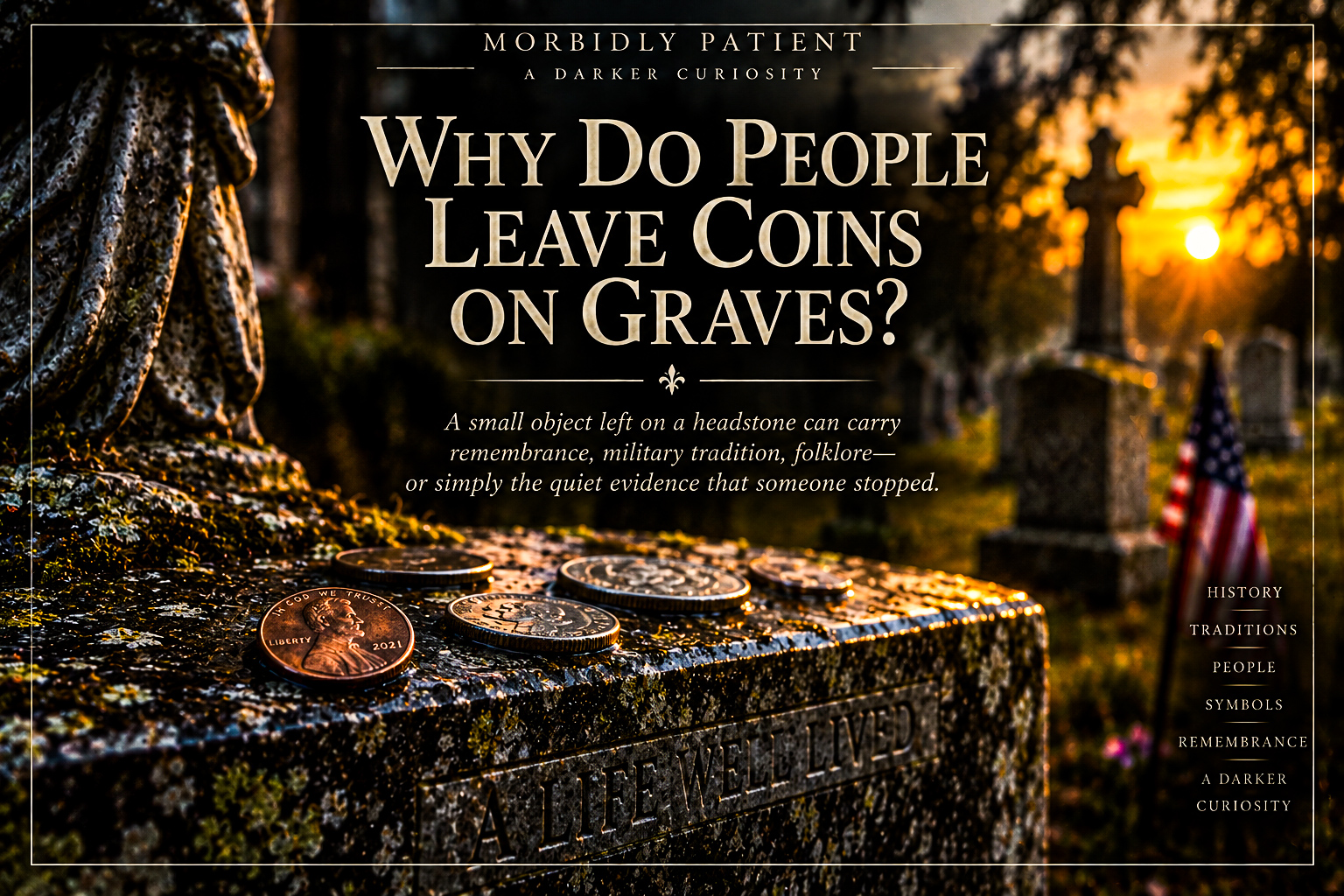
A small object left on a headstone can carry remembrance, military tradition, folklore, or simply the quiet evidence that someone stopped.
You’re walking through a cemetery when something catches the light.
A penny.
Maybe a nickel.
Perhaps several coins scattered across the top of a headstone.
Nobody appears to be around.
There isn’t a vending machine nearby.
And unless the deceased has found an unusually creative way to collect rent, the money clearly wasn’t left for them to spend.
So why is it there?
If you’ve spent any time exploring cemeteries—or scrolling through cemetery photography—you’ve probably encountered one of the most commonly repeated explanations:
A penny means you visited.
A nickel means you served together at boot camp.
A dime means you served together.
A quarter means you were there when the person died.
It’s a wonderfully tidy system.
Perhaps a little too tidy.
Because while coins absolutely are left on graves as tokens of remembrance, particularly at military graves, the history is more complicated than the viral chart makes it appear.
And coins have been accompanying the dead for a very, very long time.
The Short Answer
People leave coins on graves for several reasons.
At modern military graves, coins can function as small tokens indicating that someone visited and remembered the deceased.
At other graves, a coin may simply be an offering, tribute, personal ritual or local tradition.
And historically, coins have been associated with burial practices in numerous cultures for reasons ranging from religious belief to symbolic offerings.
What you shouldn’t automatically assume is that every denomination on every military headstone carries one universally recognized official meaning.
That’s where cemetery folklore and documented tradition begin getting mixed together.
And around here, that’s exactly the sort of thing worth digging into.
The Military Coin Tradition
Let’s begin with the explanation you’re most likely to encounter today.
Visit certain veterans’ graves and you may find coins sitting on top of the marker.
The basic meaning is easy to understand:
Someone was here.
Someone remembered.
Someone stopped long enough to leave something behind.
The more elaborate version assigns specific meanings to individual denominations.
According to the version widely shared online:
A penny means you visited.
A nickel means you trained together.
A dime means you served together.
A quarter means you were present when the person died.
It’s repeated so frequently that it often gets presented as established military protocol.
But there is an important distinction:
A widespread tradition isn’t necessarily an official military system.
Different cemeteries, veterans’ groups, families and communities may understand or practice coin-leaving differently.
The safest interpretation when you encounter a coin on a veteran’s grave is the simplest one:
Someone came to remember them.
Anything more specific requires context.
Why a Coin?
That’s the question I find more interesting.
Why not a pebble?
A flower?
A handwritten note?
Why leave money with someone who can’t spend it?
Part of the answer may simply be practicality.
Coins are small.
Durable.
Easy to carry.
They survive rain better than paper.
They sit neatly on stone.
And unlike flowers, they don’t wilt in three days.
But coins also carry symbolic weight.
Money represents value.
Exchange.
Debt.
Payment.
Luck.
Passage.
Prosperity.
And because human beings have been putting coins near dead people for thousands of years, it’s tempting to draw a straight line from ancient burial customs to every penny sitting on a modern headstone.
History rarely gives us lines that straight.
Still, the older traditions are fascinating.
The Coin for Charon
If you’ve heard of coins being placed with the dead in the ancient world, you’ve probably encountered Charon’s obol.
In Greek mythology, Charon was the ferryman associated with carrying the dead across the waters separating the world of the living from the realm of the dead.
Later literary and cultural traditions developed the familiar idea that the deceased required payment for passage.
Hence the coin.
Archaeologists have indeed found coins associated with ancient burials, sometimes placed in or near the mouth and sometimes elsewhere with the body.
But even here, we need to be careful.
Not every ancient coin found in a grave can automatically be labeled:
FERRY FEE FOR CHARON.
Burial customs varied enormously across place and time.
A coin could have ritual, religious, protective, economic or symbolic significance that we don’t fully understand.
The myth provides one explanation.
The archaeology is messier.
As usual, the mess is more interesting.
Coins, Offerings and the Dead
Coins appear in funerary contexts beyond the classical Mediterranean world as well.
That’s hardly surprising.
Humans have buried the dead with objects for thousands upon thousands of years.
Tools.
Weapons.
Jewelry.
Food.
Pottery.
Beads.
Personal belongings.
Objects whose meanings disappeared with the people who understood them.
The practice of placing something valuable with the dead can reflect beliefs about an afterlife.
But it can also represent status.
Identity.
Memory.
Protection.
Respect.
Or ritual obligations performed by the living.
Sometimes the object may tell us more about the mourners than the deceased.
Which is still true today.
A coin on a grave isn’t really being used by the dead person.
It’s doing something for—or saying something about—the person who left it.
The Things We Leave Behind
Once you start paying attention, coins become just one member of an enormous family of objects left at graves.
Flowers are obvious.
But you’ll also find:
Small stones.
Flags.
Photographs.
Letters.
Military challenge coins.
Shell casings.
Toys.
Stuffed animals.
Sports memorabilia.
Religious objects.
Jewelry.
Bottles.
Food.
Seashells.
Painted rocks.
Christmas decorations.
Birthday balloons.
And sometimes objects whose significance would make absolutely no sense to anyone except the deceased and the person who left them.
Those may be my favorites.
Because suddenly you’re looking at evidence of a relationship without knowing the story.
A tiny plastic dinosaur on a grave might look meaningless to you.
To somebody else, it might represent twenty years of memories.
Some Graves Develop Their Own Traditions
Certain famous graves accumulate objects because visitors begin imitating one another.
A tradition develops.
People leave lipstick marks.
Pens.
Playing cards.
Coins.
Stones.
Flowers.
Alcohol.
Tickets.
Letters.
Specific objects associated with the deceased.
Eventually the practice becomes part of visiting the grave itself.
And sometimes nobody is entirely certain how it began.
This is one of the fascinating things about cemeteries.
Folklore doesn’t merely live there. It continues being created there.
Someone does something.
Someone else notices.
They repeat it.
A story develops explaining why.
Enough people repeat the story and suddenly it feels ancient.
Sometimes it is.
Sometimes it started fifteen years ago.
Should You Take Coins From a Grave?
No.
That one’s easy.
If an object has been deliberately left on someone’s grave, leave it where you found it.
That includes coins.
Even if you don’t understand the significance.
Even if the coin looks old.
Even if you collect coins.
Even if it’s exactly the quarter you need for something.
It isn’t yours.
Cemetery staff may eventually remove objects as part of maintenance, and some cemeteries have specific policies governing what can be left on graves.
That’s different.
As a visitor:
Look. Photograph respectfully where permitted. Leave things alone.
The same rule applies to flowers, stones, shells and other objects.
A cemetery isn’t an antique store with unusually depressing shelving.
A Coin Is Evidence of the Living
That’s ultimately what interests me most.
We tend to think of cemeteries as places belonging to dead people.
But almost everything you see there was put there by someone alive.
The headstone.
The inscription.
The flowers.
The flag.
The little ceramic angel.
The faded photograph.
The penny balanced on top of the granite.
The dead didn’t place any of it.
We did.
Because burial rituals aren’t really performed by the dead.
They’re performed by people trying to figure out what to do with the fact that someone isn’t here anymore.
Sometimes we build enormous monuments.
Sometimes we carve someone’s name into marble.
Sometimes we buy flowers.
And sometimes the entire act of remembrance weighs about 2.5 grams.
A penny.
Almost worthless financially.
But that’s not really why it’s there.
Someone walked into a cemetery.
Found a particular name among hundreds or thousands of others.
Stopped.
Reached into a pocket.
And left behind a tiny piece of evidence:
I was here.
More importantly:
I remembered you.
For something worth one cent, that’s carrying quite a lot of weight.
Morbidly Patient
A Darker Curiosity.
For those curious enough to look where others look away.