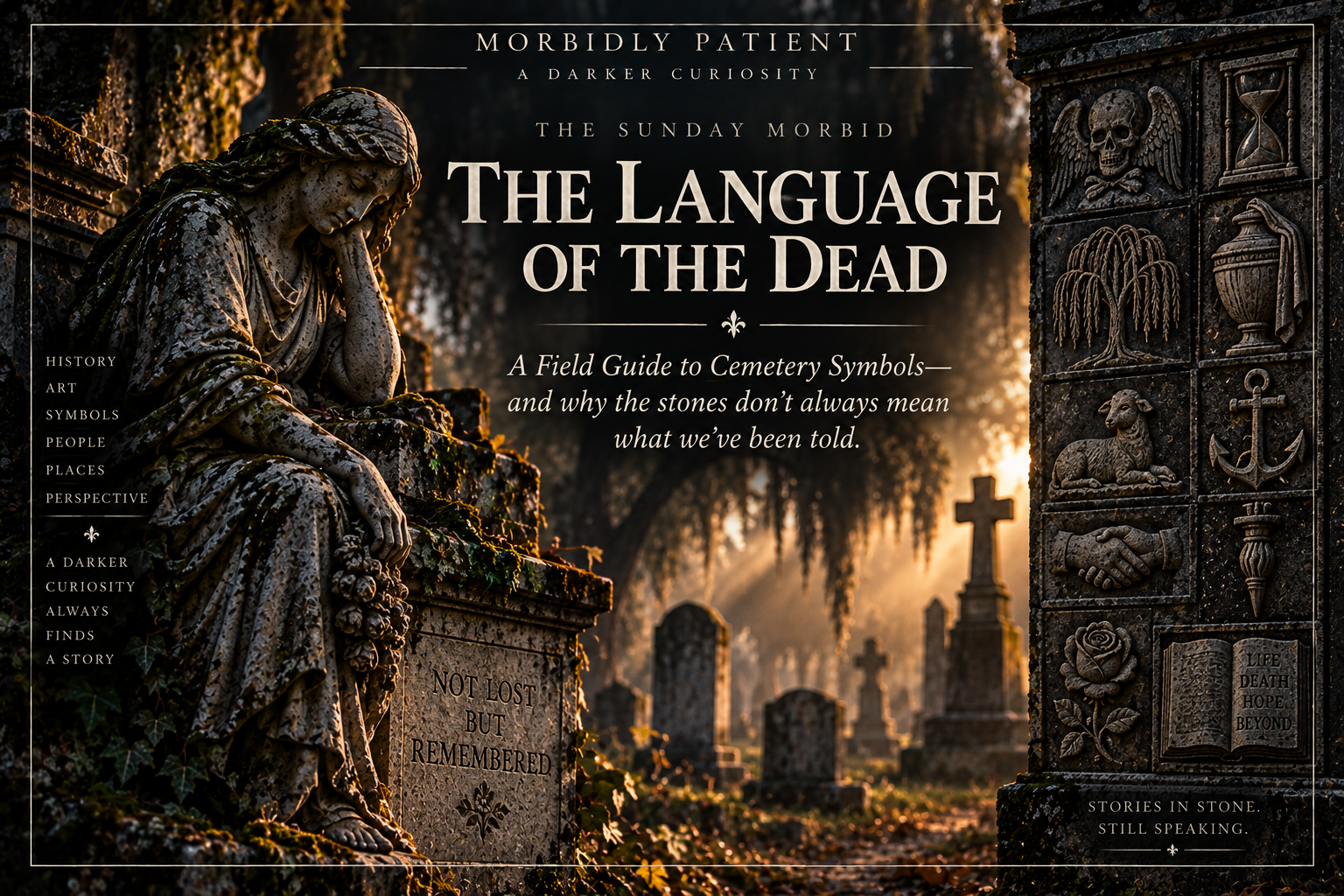
THE SUNDAY MORBID
A Field Guide to Cemetery Symbols, and why the stones don’t always mean what we’ve been told
Walk through an old cemetery long enough and eventually the stones begin to change.
At first, you see names.
Dates.
Husbands.
Wives.
Children.
A few familiar crosses.
Maybe an angel.
But then you start noticing the things nobody explained.
A hand pointing upward.
Two hands clasped together.
An anchor.
A broken column.
An urn covered with a piece of cloth.
A lamb resting above the name of a child.
A tree stump carved from stone.
Flowers that never wilt.
Books that never close.
Torches turned upside down but somehow still burning.
And suddenly you realize you’re surrounded by a language you don’t know how to read.
That’s when cemeteries get dangerous.
Not because of ghosts.
Because now you’re curious.
And curiosity has a habit of turning a twenty-minute cemetery walk into three hours of wondering why someone who died in 1887 has an upside-down torch carved into their monument.
Welcome to The Sunday Morbid.
Today we’re learning to read the dead.
A Cemetery Was Never Just a Collection of Names
We tend to think of a headstone primarily as identification.
John Smith
1841–1903
Here lies John.
That’s certainly one of its purposes.
But humans have rarely been satisfied with simply labeling our dead.
We decorate their resting places.
We’ve been doing versions of this for thousands of years.
We add flowers, animals, tools, religious imagery, geometric designs, occupational symbols, fraternal emblems and representations of objects that mattered to us.
Sometimes these images communicate beliefs about death.
Sometimes they say something about the person buried there.
Sometimes they express what the people who buried them hoped was true.
And sometimes they were chosen because somebody thought they looked nice in a monument company’s catalog.
That last possibility is worth remembering.
Because once people become interested in cemetery symbolism, there’s a temptation to treat every graveyard like an enormous stone cipher.
Rose = this.
Anchor = that.
Finger pointing down = definitely this other thing.
Real history is rarely that cooperative.
Symbols have histories.
They have contexts.
And they can have more than one meaning.
So instead of creating another internet list promising to decode every grave you encounter, let’s learn something more useful:
how to look.
The Skull: Before We Made Death Pretty
If you wander through some of the oldest colonial burial grounds in America, the imagery can be surprisingly blunt.
Skulls.
Crossbones.
Winged skulls.
Skeletons.
Hourglasses.
Death wasn’t being coy.
One particularly recognizable form is sometimes called the death’s head: a skull, often accompanied by wings.
To modern eyes it can look almost aggressively macabre.
Put the same image on a black T-shirt today and people might assume you’re advertising a metal band.
But on early gravestones, imagery involving skulls and mortality could serve as a direct reminder of the inevitable:
You will die too.
Memento mori.
Remember death.
Over time, particularly as religious and cultural attitudes changed, some funerary imagery softened.
The stark skull might give way to winged faces, cherubs or other imagery emphasizing the soul, heaven, resurrection or remembrance.
You can sometimes watch attitudes toward death change simply by walking from one section of an old cemetery into another.
Stone becomes a historical timeline.
The Hourglass: Your Sand Is Running
Few symbols require much explanation.
An hourglass says:
Time is passing.
Put wings on it and the message becomes even less subtle.
Time flies.
You’ll encounter hourglasses in funerary art because mortality is fundamentally a problem of time.
Nobody knows how much sand they received.
You simply notice at some point that there’s less in the top than there used to be.
An hourglass carved into stone can function as another form of memento mori: life is brief, time passes, death comes.
Centuries later, we replaced the hourglass with calendars, watches and glowing screens.
The problem remains remarkably unchanged.
The Urn: A Vessel for What Remains
The urn became an especially prominent funerary symbol in the eighteenth and nineteenth centuries.
That sometimes confuses modern cemetery visitors because the person beneath an urn-carved monument wasn’t necessarily cremated.
The image could be symbolic rather than literal.
Urns had long-standing associations with death, antiquity and the remains of the deceased, making them useful visual shorthand for mourning.
Then you’ll find one with fabric draped across it.
The draped urn or veiled urn.
The drapery is commonly interpreted in connection with mourning, sorrow and the veil separating life from death.
It’s beautiful imagery.
A vessel associated with the dead partially covered by cloth.
Something present.
Something concealed.
Something we can see but not fully reach.
Whether every nineteenth-century person who purchased one intended precisely that philosophical interpretation is another question.
But by the Victorian period, the draped urn had become one of the recognizable visual languages of mourning.
The Weeping Willow: Grief in Stone
Once you recognize the weeping willow, you’ll start seeing it everywhere.
Its branches bend downward.
Its entire posture appears sorrowful.
You barely need a symbolism guide.
The tree looks like it’s grieving.
Willows became particularly associated with mourning imagery in the eighteenth and nineteenth centuries and appear frequently on gravestones, mourning art and related objects.
Sometimes you’ll see the willow paired with an urn.
It’s almost an entire funeral compressed into one image:
the vessel of death beneath a tree that seems to mourn it.
There’s another reason trees work so beautifully in funerary symbolism.
They change.
Lose leaves.
Appear dead.
Return.
Grow from the earth.
Outlive us.
Whether the intended message is sorrow, renewal, immortality or simply fashionable mourning imagery depends upon context.
Which is why context keeps following us around the cemetery.
The Broken Column: A Life Interrupted
A stone column rises from a monument.
Then suddenly ends.
Broken.
At first glance you might assume the cemetery has simply damaged it.
Sometimes that’s exactly what happened.
But sometimes the broken column was carved that way intentionally.
It is commonly associated with a life cut short.
The architectural form was supposed to continue upward.
It didn’t.
Neither did the person’s life.
That’s a powerful visual metaphor requiring very few words.
But here’s where careful observation matters.
Don’t assume every broken cemetery column is symbolic.
Look at the break.
Is it carved and finished?
Or jagged and weather-damaged?
Is there evidence something once sat on top?
Was the monument vandalized?
Did a tree limb hit it?
Sometimes symbolism is intentional.
Sometimes gravity happened.
The Lamb: Look at the Dates
You notice a little stone lamb.
Before reading anything else, look at the dates.
There’s a good chance you’re standing at the grave of a child.
Lambs became strongly associated with children’s graves, drawing upon ideas of innocence, gentleness and Christian imagery surrounding Christ as shepherd and lamb.
Few cemetery symbols hit quite the same way.
Perhaps because the sculpture is so gentle.
Perhaps because you know what you’re likely to find before reading the inscription.
Then you see:
Born 1892
Died 1894
And suddenly the cute little stone animal isn’t decorative anymore.
It’s grief.
Someone stood where you’re standing and buried a child.
The lamb was what they chose to leave behind.
The Dove: Peace, Spirit and Departure
Doves appear throughout Christian art and can represent the Holy Spirit, peace, purity and the soul.
In cemetery imagery, a dove may suggest spiritual peace or the soul’s ascent.
But again, details can matter.
A bird flying upward may create a different impression from one resting quietly.
A dove carrying an olive branch brings another familiar layer of meaning.
And sometimes?
A bird is a bird.
The goal isn’t to interrogate every feather until the deceased reveals a secret.
It’s to recognize the visual traditions from which these images came.
The Anchor: Hope Beneath the Surface
An anchor on a grave seems almost obvious if the deceased was a sailor.
And sometimes that’s exactly what it means.
But anchors also became important Christian symbols.
The association between an anchor and hope has ancient Christian roots, drawing particularly from the biblical metaphor of hope as an anchor of the soul.
So when you encounter an anchor, don’t immediately conclude:
Sailor.
Check the rest of the monument.
Military information?
Occupation?
Religious imagery?
Dates?
Other symbols?
An anchor could speak of profession.
Faith.
Hope.
Or multiple things simultaneously.
Symbols aren’t always vocabulary words with one definition.
Sometimes they’re sentences.
The Clasped Hands: Goodbye—or Something More?
Two hands clasped together appear frequently on nineteenth-century monuments.
They’re often interpreted as farewell.
A final handshake.
Parting between the living and the dead.
Sometimes the cuffs provide clues about gender, suggesting husband and wife.
In other contexts, clasped hands may represent reunion, marriage, fellowship or particular religious and fraternal associations.
And that’s why this symbol is such a good lesson in cemetery reading.
You don’t merely see:
hands = farewell.
You ask:
Whose grave?
What’s written nearby?
Are there matching family monuments?
What do the sleeves look like?
Is there an inscription about reunion?
What other imagery accompanies it?
You’re no longer decoding.
You’re investigating.
That’s considerably more fun.
The Finger Pointing Up
This one seems refreshingly straightforward.
A hand with the index finger pointing toward heaven.
Up.
The soul has ascended.
Heaven awaits.
Problem solved.
And often, yes, that’s the general message.
But cemetery enthusiasts sometimes encounter the opposite:
a finger pointing downward.
That’s when things get entertaining.
Because modern viewers immediately think:
Well.
That doesn’t seem promising.
But a downward-pointing hand doesn’t automatically mean the deceased was sent somewhere considerably warmer.
It can represent God reaching down from heaven.
Mortality.
A life being called from earth.
Or other religious ideas depending upon the design and context.
This is a perfect example of why we shouldn’t read old funerary imagery through modern visual assumptions alone.
Sometimes down isn’t hell.
The Upside-Down Torch: Death Without Extinction
An inverted torch looks wrong.
That’s precisely why it works.
The torch is associated with life, light and vitality.
Turn it upside down and you have a powerful image of death.
But look carefully at many carved inverted torches.
The flame is still burning.
Life has ended.
The flame has not necessarily been extinguished.
That tension allowed the inverted torch to carry ideas about death alongside continuing life, immortality or the persistence of the spirit.
The body has been turned toward the earth.
The flame remains.
It’s one of those cemetery symbols that becomes much more beautiful once somebody teaches you to notice it.
The Poppy: Sleep
Long before poppies became strongly associated with military remembrance, the flower carried associations with sleep.
That connection is understandable.
Certain poppies produce substances with sedative and narcotic effects, and the flower became associated with sleep, dreams and death.
In funerary art, poppies can therefore suggest:
eternal sleep.
Death represented not as destruction, but rest.
Which connects with another word we’ve already explored around here.
Cemetery itself ultimately traces through Greek to a word associated with a sleeping place.
The dead sleep.
The poppy grows above them.
Language and imagery sometimes arrive at the same metaphor by different roads.
The Rose: Don’t Overinterpret the Flower Garden
Flowers are everywhere in funerary art.
Roses especially.
Love.
Beauty.
Purity.
Youth.
Mortality.
Different stages of bloom can suggest different ideas, and cemetery guides often assign elaborate meanings based upon whether a rose is a bud, partially opened or fully bloomed.
Some of those interpretations have historical grounding in broader floral symbolism.
But here’s where I become cautious.
Victorian flower symbolism was real.
It was also variable.
Meanings differed among books, places and periods.
And decorative carving doesn’t always function like a coded telegram.
So admire the rose.
Research the period.
Look for patterns.
But don’t confidently reconstruct someone’s entire biography because the stonecutter carved three petals instead of four.
Sometimes our desire to find meaning becomes stronger than the evidence.
The Book: What Was Written?
Open books appear regularly on cemetery monuments.
They can represent the Bible.
Faith.
Learning.
Knowledge.
The Book of Life.
Or the story of the deceased’s life.
Sometimes the inscription makes the meaning obvious.
Sometimes it doesn’t.
A book-shaped monument may even serve as the primary structure of the marker itself.
There’s something appropriate about that.
A life presented as a book.
The final page already written.
Everyone else standing around trying to understand the story from whatever lines remain visible.
The Tree Stump: A Surprisingly Literal Metaphor
Every once in a while you’ll encounter a gravestone that looks like somebody petrified a tree.
Bark.
Cut branches.
Roots.
Sometimes even little carved objects attached to it.
These tree-stump monuments became particularly popular around the late nineteenth and early twentieth centuries.
Some are connected with fraternal organizations such as Woodmen of the World, which helped provide monuments for members during parts of its history.
Others simply use the tree as funerary imagery.
And again, the metaphor works almost immediately.
A tree has been cut down.
A life has ended.
Branches may represent family members.
The trunk remains.
Nature translated into stone.
Stone pretending to be wood.
Something once alive represented by something that never was.
Cemeteries are strange places.
The Obelisk: Ancient Egypt Comes to the Cemetery
Then there are the obelisks.
Tall.
Narrow.
Tapered.
Pointed at the top.
They appear throughout nineteenth-century cemeteries, particularly during periods when Western culture became fascinated with ancient Egypt.
Obelisks carried associations with antiquity, monumentality, permanence and Egyptian civilization.
They also solved a practical problem.
If you wanted your family monument to be visible from halfway across the cemetery, an obelisk did the job nicely.
Symbolism and status frequently make excellent neighbors.
The Square and Compasses, Three Links and Other Symbols That Aren’t About Death
Not every symbol on a grave is funerary.
Some tell you about the organizations a person belonged to while alive.
The square and compasses may indicate Freemasonry.
Three interlocking links are associated with the Independent Order of Odd Fellows, commonly interpreted through the organization’s ideals of friendship, love and truth.
Other markers display insignia associated with veterans’ groups, religious organizations, occupational societies and fraternal orders.
These symbols can be extraordinarily useful historically.
They tell us something the birth and death dates don’t.
This person belonged somewhere.
They had a community.
An identity.
Relationships beyond the family name carved beneath them.
Sometimes the symbol is our first clue to an entire forgotten part of their life.
But Here’s the Rule I Want Us to Remember
If you remember nothing else from this article, remember this:
Cemetery symbols do not have a universal dictionary.
That may be disappointing.
I think it’s wonderful.
Because it means we’re allowed to remain curious.
A symbol’s meaning can depend upon:
the period,
the region,
religious tradition,
fraternal membership,
local customs,
the monument manufacturer,
the accompanying inscription,
the other symbols around it,
and the intentions of the people who purchased the stone.
Those little online graphics promising:
17 Cemetery Symbols and EXACTLY What They Mean
are useful starting points.
They are not Rosetta Stones.
If you find an unusual symbol, don’t stop after looking it up on Pinterest.
Photograph it.
Read the entire monument.
Look at nearby family stones.
Check the date.
Research the cemetery.
Research the person.
Research the organization if initials appear.
Find historical monument catalogs if possible.
Ask whether the interpretation you’re reading actually existed when the stone was erected.
That’s when cemetery wandering becomes historical investigation.
Look Before You Look It Up
Here’s something I’d encourage you to try the next time you visit a cemetery.
When you find an unfamiliar symbol, don’t immediately pull out your phone.
Look first.
Really look.
What’s depicted?
What direction is it facing?
Is something broken?
Open?
Closed?
Burning?
Wilting?
Flying?
Pointing?
What other objects surround it?
Read the inscription.
Read the dates.
Look at neighboring graves.
Try to understand what the image communicates before someone on the internet tells you what you’re supposed to see.
Then research it.
You may be right.
You may be completely wrong.
Either outcome makes the walk more interesting.
The Stones Are Talking About the Living
There’s an irony beneath all of this.
We call these symbols of the dead.
But the dead didn’t choose most of them.
The living did.
A grieving mother chose the lamb.
A widow approved the clasped hands.
A family selected the urn.
A fraternity placed its emblem on a member’s grave.
A monument maker showed someone a catalog.
Someone chose one design instead of another.
Which means funerary symbolism doesn’t only tell us what people believed about death.
It tells us what the living needed to say when death happened.
He was a Mason.
She was loved.
Our child was innocent.
We believe we’ll meet again.
His life ended too soon.
Her soul went somewhere beyond this place.
Remember them.
The symbols become fragments of conversations between people who can no longer speak to one another.
And then, decades or centuries later, we wander through with our cameras and notebooks trying to listen.
Eventually, Even the Language Disappears
There’s another layer to all of this that I find difficult to ignore.
The symbols themselves don’t last.
Marble erodes.
Sandstone crumbles.
Letters soften.
Hands lose fingers.
Angels lose faces.
Iron rusts.
Trees fall across monuments.
Lichen slowly covers names.
A carving that once communicated something obvious becomes a shallow shape nobody notices.
Sometimes you encounter a monument and realize that the person who commissioned it believed they were creating something permanent.
Stone feels permanent.
Until you spend enough time around old stone.
Then you realize it’s merely patient.
The monument is disappearing.
Just much more slowly than the person beneath it did.
Maybe that’s one reason I photograph these things.
A photograph won’t defeat time either.
But for a little while, it notices.
Learn to Read the Cemetery
The next time you enter a cemetery, don’t begin with the names.
Step back.
Look at the shapes.
Find the oldest section.
Notice which symbols repeat.
Watch how the imagery changes as the decades pass.
Find the lamb.
The willow.
The hand.
The anchor.
The urn.
The torch.
The book.
The strange emblem you’ve never seen before.
Then get closer.
Read the names.
Read the dates.
Ask questions.
Because once you learn even a little of this language, a cemetery stops looking like a field filled with stones.
It becomes something closer to a library.
Except the books are standing upright in the grass.
Some pages have disappeared.
Some are written in languages we’ve forgotten.
Some stories are only a name and two dates.
And every now and then, if you’re curious enough to stop and look closely, someone who hasn’t spoken in a hundred years manages to tell you something.
Not from beyond the grave.
Nothing supernatural is required.
They already left the message.
We just forgot how to read it.
Morbidly Patient
A Darker Curiosity.
For those curious enough to look where others look away.