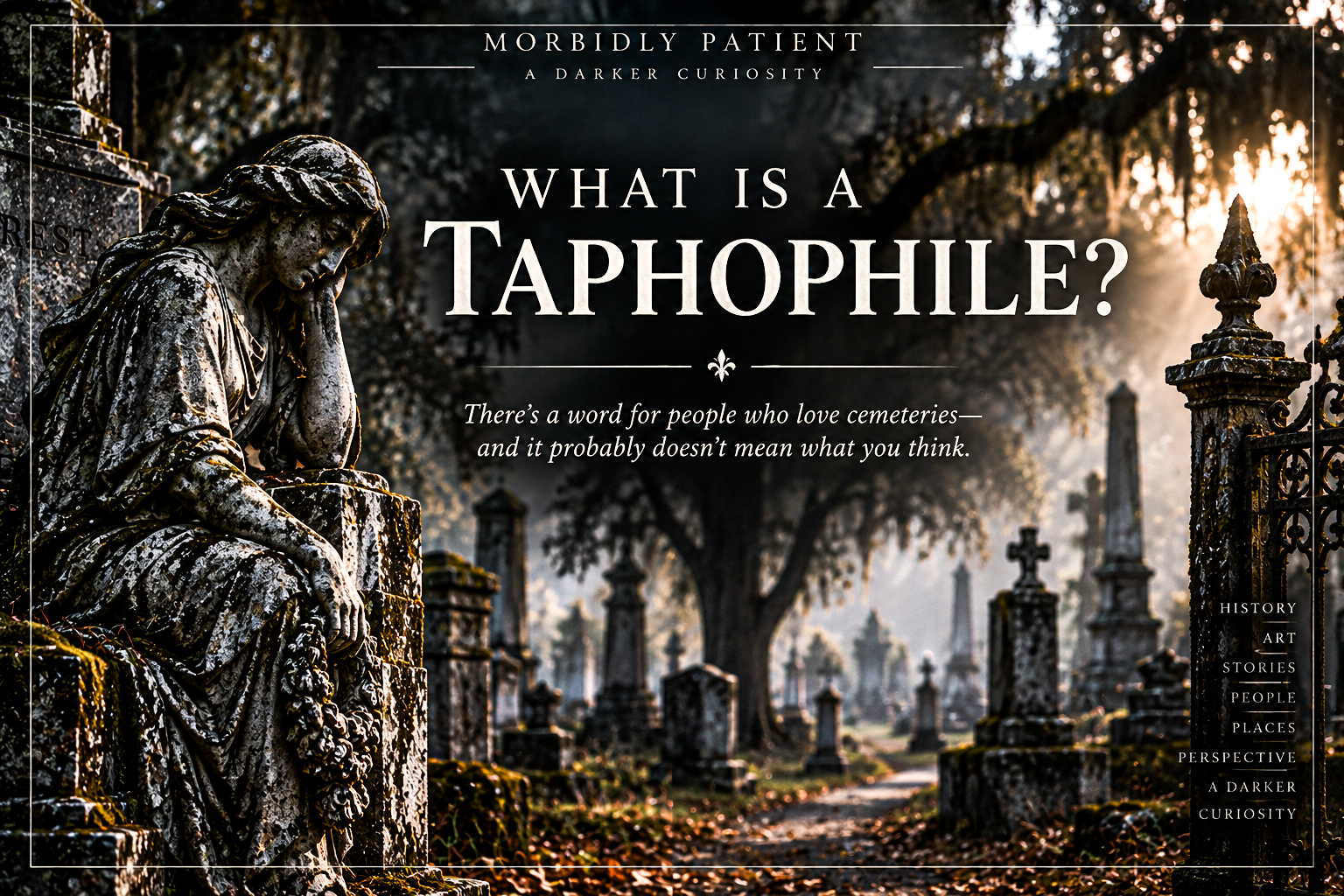
There’s a word for people who love cemeteries—and it probably doesn’t mean what you think.
Maybe you’ve always done it.
You’re driving somewhere when you pass an old cemetery.
Not one of the perfectly manicured modern ones.
An old one.
Crooked stones.
Large trees.
Maybe an iron fence.
A few monuments leaning at angles they definitely weren’t installed at.
And almost automatically you look over and think:
I wonder what’s in there.
Not in a paranormal-investigation sort of way.
You aren’t necessarily expecting ghosts.
You’re wondering how old the cemetery is.
Who is buried there.
Whether there are interesting monuments.
What the oldest stone says.
Whether there are symbols you’ve never seen before.
Maybe you want to photograph it.
Maybe you want to walk among the graves and read names belonging to people who haven’t heard their names spoken aloud in a century.
Maybe your traveling companion sees absolutely nothing unusual about your suggestion:
“We’ve got twenty minutes. Want to walk through that cemetery?”
Or maybe they look at you like you’ve just proposed spending the afternoon at the county morgue.
If any of this sounds familiar, there’s a word you may want to know.
Taphophile.
And despite how ominous it sounds, it doesn’t mean someone who wants to do anything disturbing with dead bodies.
It basically means:
You really like cemeteries.
Welcome to the club.
What Does Taphophile Mean?
A taphophile is someone with a strong interest in cemeteries, graves, tombstones, funerary monuments and related subjects.
The word combines Greek roots associated with tomb or burial and love or affinity.
Essentially:
a lover of graves.
That sounds considerably more sinister than the reality usually is.
Taphophiles may be interested in:
Cemetery history.
Genealogy.
Gravestone symbolism.
Funerary art.
Architecture.
Photography.
Epitaphs.
Local history.
Stone carving.
Historic preservation.
Burial customs.
Or simply the experience of wandering through old cemeteries.
There’s no membership card.
No initiation ritual.
No required black wardrobe.
And you aren’t required to own a raven.
Although admittedly, a raven would improve the aesthetic considerably.
Isn’t That a Little Morbid?
Yes.
That’s sort of the point.
But morbid doesn’t necessarily mean unhealthy, miserable or obsessed with death.
The word has accumulated plenty of negative baggage, but curiosity about death is one of the most persistent features of human culture.
We’ve built pyramids for dead people.
Written books about death.
Painted it.
Photographed it.
Created elaborate funeral rituals.
Preserved bodies.
Carved monuments.
Written poems for the dead.
Built entire cities devoted to housing their remains.
Humans are a death-curious species.
Some of us are simply less interested in pretending otherwise.
And cemeteries happen to be extraordinary places for exploring that curiosity.
Cemeteries Are Outdoor Museums
This is one reason I think people misunderstand taphophiles.
If you’ve never learned to read a cemetery, you may see:
rows of tombstones.
Once you begin paying attention, you see considerably more.
A cemetery can be an outdoor museum containing sculpture, architecture, typography, religion, social history, genealogy, craftsmanship, botany and folklore.
A broken column may tell you something.
So can clasped hands.
An anchor.
A lamb.
An urn.
A willow tree.
A finger pointing upward.
A particular flower.
Symbols belonging to fraternal organizations.
Military insignia.
Occupational imagery.
Even the material used to make a monument can help place it within a particular period.
Then there are the inscriptions.
Some are painfully simple.
Some are beautiful.
Some are unintentionally funny.
Some tell you almost nothing.
Others give you enough information to send you down a historical rabbit hole for the next three hours.
A cemetery isn’t merely where history is buried.
Sometimes it’s where history is still visible.
You just have to learn how to look.
Every Stone Is a Tiny Biography
Here’s something else that happens when you spend enough time in cemeteries.
The stones stop being scenery.
You start reading them.
Elizabeth Morgan
1847–1903
That’s almost nothing.
A name.
Two dates.
Fifty-six years reduced to a few inches of carved stone.
But then your brain starts doing something troublesome.
Who was Elizabeth?
What did she sound like?
Did she have children?
What did she worry about?
What did she think the future would look like?
Did she ever imagine a stranger would stand above her grave more than a century later wondering about her?
Sometimes another stone nearby gives you part of the answer.
Her husband.
A child.
Her parents.
Maybe several children who died unusually close together.
Suddenly the cemetery isn’t a collection of objects anymore.
It’s a collection of interrupted stories.
And perhaps that’s part of what draws some taphophiles back.
The stones remind us that history wasn’t populated by historical characters.
It was populated by people.
People who were once every bit as alive and ordinary as we are.
Why Do People Photograph Cemeteries?
Photography and taphophilia naturally find one another.
It’s easy to understand why.
Cemeteries are visually extraordinary.
Weathered marble.
Lichen.
Moss.
Iron fences.
Sculpture.
Symmetry.
Decay.
Old trees.
Changing light.
Fog.
Architecture.
The contrast between objects intended to be permanent and nature slowly demonstrating that nothing actually is.
But cemetery photography can also preserve something.
Gravestones deteriorate.
Marble inscriptions disappear.
Markers are damaged.
Trees fall.
Cemeteries are vandalized.
Family burial grounds become overgrown.
Development encroaches.
Sometimes a photograph taken casually twenty years ago becomes a historical record of something that no longer exists in the same condition.
The photograph becomes another kind of memorial.
A record of a record.
Do Taphophiles Believe in Ghosts?
Some do.
Some don’t.
The two interests overlap, but they aren’t the same thing.
You can be fascinated by cemeteries without believing they’re inhabited by anything except squirrels, insects, birds and the occasional irritated groundskeeper.
You can also be deeply interested in ghosts, paranormal folklore and supernatural traditions.
Neither is a requirement.
That’s important around here.
We don’t need to manufacture supernatural stories to make cemeteries interesting.
The documented history is usually strange enough.
If there’s a ghost story associated with a place, we’ll happily explore the folklore.
But folklore and evidence aren’t necessarily the same thing.
“I don’t know” remains a perfectly acceptable answer.
There Is an Etiquette to This
Being interested in cemeteries doesn’t mean treating them like amusement parks.
They’re historical spaces.
They’re also places where people have buried people they loved.
Sometimes very recently.
So wandering cemeteries comes with a few basic expectations.
Respect posted hours and rules.
Don’t climb on monuments.
Don’t move objects.
Don’t take souvenirs.
Don’t disturb flowers, coins or other items left at graves.
Be particularly considerate around active funerals and grieving visitors.
Be thoughtful when photographing identifiable people visiting graves.
And if a cemetery prohibits photography, respect that.
Most of this shouldn’t require a rulebook.
The simplest guideline is:
Be curious without becoming intrusive.
The dead may not care what you’re doing.
The living sometimes do.
Maybe You’ve Been a Taphophile for Years
That’s the funny thing about discovering the word.
You may have had the interest long before you knew anyone had bothered naming it.
Maybe you photograph old stones.
Maybe you search for forgotten family cemeteries.
Maybe you study funerary symbols.
Maybe you read epitaphs.
Maybe you enjoy the silence.
Maybe you’re interested in the art.
Maybe walking through a cemetery makes mortality feel a little less abstract.
Or maybe you’re simply incapable of passing an old iron cemetery gate without wondering what’s on the other side.
You don’t need to justify it.
You don’t have to make it spooky.
And you certainly don’t have to believe anything in particular about what happens to the people underneath those stones.
Curiosity is enough.
In fact, that’s largely what Morbidly Patient is built around.
Not an obsession with dying.
A curiosity about the enormous collection of things human beings have created because we know that we do.
Cemeteries just happen to be one of the best places to see it.
So the next time somebody asks why you want to spend a perfectly pleasant Saturday afternoon wandering among dead people, you have options.
You could explain the history.
The sculpture.
The genealogy.
The photography.
The architecture.
The symbolism.
The preservation.
Or you could save yourself a considerable amount of time.
Tell them:
“I’m a taphophile.”
Then walk away without explaining what it means.
Sometimes a little mystery is good for people.
Morbidly Patient
A Darker Curiosity.
For those curious enough to look where others look away.
Leave a Reply