Tag: cemetery

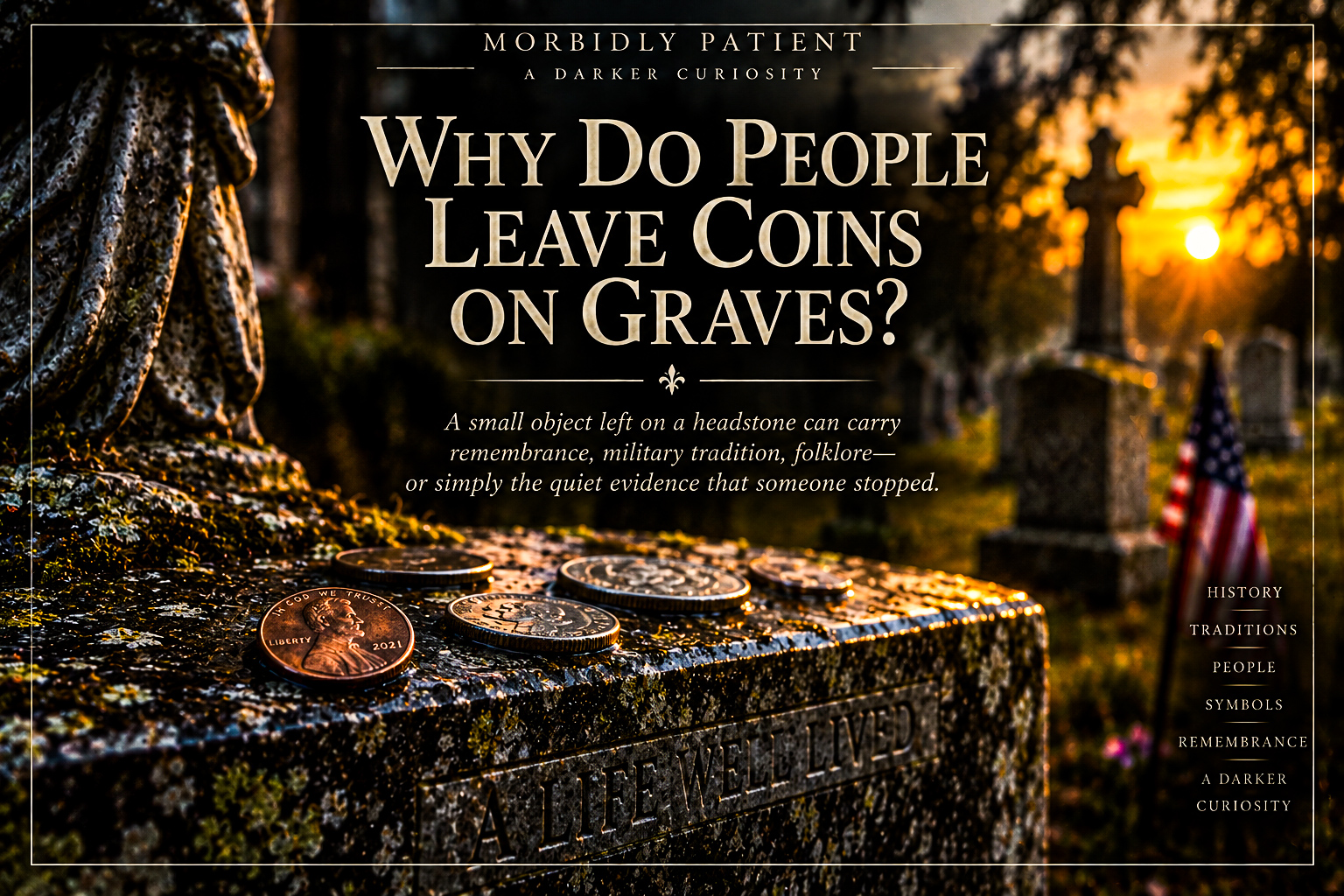
  • Why Do People Leave Coins on Graves?

    Why Do People Leave Coins on Graves?

    A small object left on a headstone can carry remembrance, military tradition, folklore, or simply the quiet evidence that someone stopped.

    You’re walking through a cemetery when something catches the light.

    A penny.

    Maybe a nickel.

    Perhaps several coins scattered across the top of a headstone.

    Nobody appears to be around.

    There isn’t a vending machine nearby.

    And unless the deceased has found an unusually creative way to collect rent, the money clearly wasn’t left for them to spend.

    So why is it there?

    If you’ve spent any time exploring cemeteries—or scrolling through cemetery photography—you’ve probably encountered one of the most commonly repeated explanations:

    A penny means you visited.

    A nickel means you served together at boot camp.

    A dime means you served together.

    A quarter means you were there when the person died.

    It’s a wonderfully tidy system.

    Perhaps a little too tidy.

    Because while coins absolutely are left on graves as tokens of remembrance, particularly at military graves, the history is more complicated than the viral chart makes it appear.

    And coins have been accompanying the dead for a very, very long time.


    The Short Answer

    People leave coins on graves for several reasons.

    At modern military graves, coins can function as small tokens indicating that someone visited and remembered the deceased.

    At other graves, a coin may simply be an offering, tribute, personal ritual or local tradition.

    And historically, coins have been associated with burial practices in numerous cultures for reasons ranging from religious belief to symbolic offerings.

    What you shouldn’t automatically assume is that every denomination on every military headstone carries one universally recognized official meaning.

    That’s where cemetery folklore and documented tradition begin getting mixed together.

    And around here, that’s exactly the sort of thing worth digging into.


    The Military Coin Tradition

    Let’s begin with the explanation you’re most likely to encounter today.

    Visit certain veterans’ graves and you may find coins sitting on top of the marker.

    The basic meaning is easy to understand:

    Someone was here.

    Someone remembered.

    Someone stopped long enough to leave something behind.

    The more elaborate version assigns specific meanings to individual denominations.

    According to the version widely shared online:

    A penny means you visited.

    A nickel means you trained together.

    A dime means you served together.

    A quarter means you were present when the person died.

    It’s repeated so frequently that it often gets presented as established military protocol.

    But there is an important distinction:

    A widespread tradition isn’t necessarily an official military system.

    Different cemeteries, veterans’ groups, families and communities may understand or practice coin-leaving differently.

    The safest interpretation when you encounter a coin on a veteran’s grave is the simplest one:

    Someone came to remember them.

    Anything more specific requires context.


    Why a Coin?

    That’s the question I find more interesting.

    Why not a pebble?

    A flower?

    A handwritten note?

    Why leave money with someone who can’t spend it?

    Part of the answer may simply be practicality.

    Coins are small.

    Durable.

    Easy to carry.

    They survive rain better than paper.

    They sit neatly on stone.

    And unlike flowers, they don’t wilt in three days.

    But coins also carry symbolic weight.

    Money represents value.

    Exchange.

    Debt.

    Payment.

    Luck.

    Passage.

    Prosperity.

    And because human beings have been putting coins near dead people for thousands of years, it’s tempting to draw a straight line from ancient burial customs to every penny sitting on a modern headstone.

    History rarely gives us lines that straight.

    Still, the older traditions are fascinating.


    The Coin for Charon

    If you’ve heard of coins being placed with the dead in the ancient world, you’ve probably encountered Charon’s obol.

    In Greek mythology, Charon was the ferryman associated with carrying the dead across the waters separating the world of the living from the realm of the dead.

    Later literary and cultural traditions developed the familiar idea that the deceased required payment for passage.

    Hence the coin.

    Archaeologists have indeed found coins associated with ancient burials, sometimes placed in or near the mouth and sometimes elsewhere with the body.

    But even here, we need to be careful.

    Not every ancient coin found in a grave can automatically be labeled:

    FERRY FEE FOR CHARON.

    Burial customs varied enormously across place and time.

    A coin could have ritual, religious, protective, economic or symbolic significance that we don’t fully understand.

    The myth provides one explanation.

    The archaeology is messier.

    As usual, the mess is more interesting.


    Coins, Offerings and the Dead

    Coins appear in funerary contexts beyond the classical Mediterranean world as well.

    That’s hardly surprising.

    Humans have buried the dead with objects for thousands upon thousands of years.

    Tools.

    Weapons.

    Jewelry.

    Food.

    Pottery.

    Beads.

    Personal belongings.

    Objects whose meanings disappeared with the people who understood them.

    The practice of placing something valuable with the dead can reflect beliefs about an afterlife.

    But it can also represent status.

    Identity.

    Memory.

    Protection.

    Respect.

    Or ritual obligations performed by the living.

    Sometimes the object may tell us more about the mourners than the deceased.

    Which is still true today.

    A coin on a grave isn’t really being used by the dead person.

    It’s doing something for—or saying something about—the person who left it.


    The Things We Leave Behind

    Once you start paying attention, coins become just one member of an enormous family of objects left at graves.

    Flowers are obvious.

    But you’ll also find:

    Small stones.

    Flags.

    Photographs.

    Letters.

    Military challenge coins.

    Shell casings.

    Toys.

    Stuffed animals.

    Sports memorabilia.

    Religious objects.

    Jewelry.

    Bottles.

    Food.

    Seashells.

    Painted rocks.

    Christmas decorations.

    Birthday balloons.

    And sometimes objects whose significance would make absolutely no sense to anyone except the deceased and the person who left them.

    Those may be my favorites.

    Because suddenly you’re looking at evidence of a relationship without knowing the story.

    A tiny plastic dinosaur on a grave might look meaningless to you.

    To somebody else, it might represent twenty years of memories.


    Some Graves Develop Their Own Traditions

    Certain famous graves accumulate objects because visitors begin imitating one another.

    A tradition develops.

    People leave lipstick marks.

    Pens.

    Playing cards.

    Coins.

    Stones.

    Flowers.

    Alcohol.

    Tickets.

    Letters.

    Specific objects associated with the deceased.

    Eventually the practice becomes part of visiting the grave itself.

    And sometimes nobody is entirely certain how it began.

    This is one of the fascinating things about cemeteries.

    Folklore doesn’t merely live there. It continues being created there.

    Someone does something.

    Someone else notices.

    They repeat it.

    A story develops explaining why.

    Enough people repeat the story and suddenly it feels ancient.

    Sometimes it is.

    Sometimes it started fifteen years ago.


    Should You Take Coins From a Grave?

    No.

    That one’s easy.

    If an object has been deliberately left on someone’s grave, leave it where you found it.

    That includes coins.

    Even if you don’t understand the significance.

    Even if the coin looks old.

    Even if you collect coins.

    Even if it’s exactly the quarter you need for something.

    It isn’t yours.

    Cemetery staff may eventually remove objects as part of maintenance, and some cemeteries have specific policies governing what can be left on graves.

    That’s different.

    As a visitor:

    Look. Photograph respectfully where permitted. Leave things alone.

    The same rule applies to flowers, stones, shells and other objects.

    A cemetery isn’t an antique store with unusually depressing shelving.


    A Coin Is Evidence of the Living

    That’s ultimately what interests me most.

    We tend to think of cemeteries as places belonging to dead people.

    But almost everything you see there was put there by someone alive.

    The headstone.

    The inscription.

    The flowers.

    The flag.

    The little ceramic angel.

    The faded photograph.

    The penny balanced on top of the granite.

    The dead didn’t place any of it.

    We did.

    Because burial rituals aren’t really performed by the dead.

    They’re performed by people trying to figure out what to do with the fact that someone isn’t here anymore.

    Sometimes we build enormous monuments.

    Sometimes we carve someone’s name into marble.

    Sometimes we buy flowers.

    And sometimes the entire act of remembrance weighs about 2.5 grams.

    A penny.

    Almost worthless financially.

    But that’s not really why it’s there.

    Someone walked into a cemetery.

    Found a particular name among hundreds or thousands of others.

    Stopped.

    Reached into a pocket.

    And left behind a tiny piece of evidence:

    I was here.

    More importantly:

    I remembered you.

    For something worth one cent, that’s carrying quite a lot of weight.

    Morbidly Patient
    A Darker Curiosity.

    For those curious enough to look where others look away.
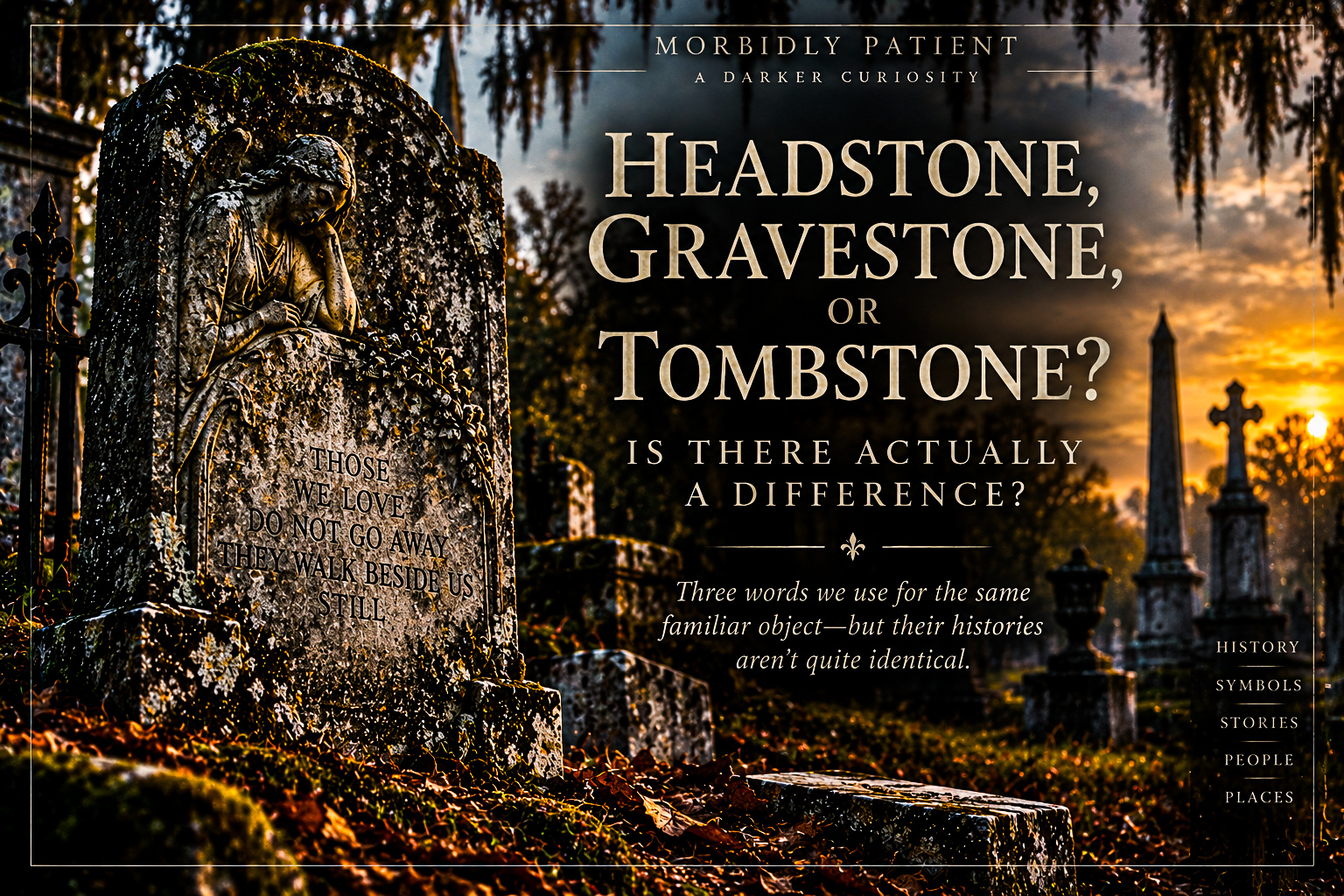
  • Headstone, Gravestone, or Tombstone: Is There Actually a Difference?

    Headstone, Gravestone, or Tombstone: Is There Actually a Difference?

    Three words we use for the same familiar object, but their histories aren’t quite identical.

    You’re walking through an old cemetery when you find a stone that makes you stop.

    Maybe it’s leaning slightly to one side.

    Maybe moss has crept across the inscription.

    Maybe the name is still perfectly readable while the dates beneath it have almost disappeared.

    You take a photograph.

    And later, when you’re writing the caption, you encounter an unexpectedly difficult question:

    What exactly do you call the thing?

    A headstone?

    A gravestone?

    A tombstone?

    Surely there must be a rule.

    After all, the internet loves rules.

    You’ll find explanations confidently informing you that a headstone goes at the head, a footstone goes at the feet, a gravestone covers a grave, and a tombstone originally sealed a tomb.

    Some of that has historical reasoning behind it.

    Some of it is language being tidied up after the fact.

    Because in modern English, headstone, gravestone, and tombstone are largely interchangeable.

    But they didn’t all take exactly the same path to get here.

    And those paths tell us something interesting about how we have marked our dead.


    The Short Answer

    If you’re talking about the upright stone marker carrying someone’s name, dates, and perhaps an epitaph, you can usually call it a:

    headstone

    gravestone

    or

    tombstone

    …and people will know exactly what you mean.

    In contemporary usage, headstone and gravestone are particularly straightforward terms for a marker placed at a grave.

    Tombstone is also widely used that way.

    There isn’t a Cemetery Vocabulary Enforcement Division waiting behind the mausoleum to issue citations.

    But historically, the words developed from somewhat different ideas.

    So let’s dig them up.


    What Is a Headstone?

    This one seems obvious.

    A headstone is a stone placed at the head of a grave.

    And historically, that’s essentially where the term comes from.

    In some burial traditions, a grave could be marked at both ends.

    The larger marker at the head was the headstone.

    A smaller marker at the opposite end could be the footstone.

    You can still find this arrangement in older cemeteries.

    Sometimes the footstone carries initials.

    Sometimes it contains little information at all.

    Sometimes it’s simply there to mark the physical boundary of the grave.

    That creates something we’re prone to forgetting when wandering through cemeteries today:

    A grave marker wasn’t always merely a commemorative sign.

    It could also help tell you where the grave actually was.

    The headstone marked one end.

    The footstone marked the other.

    The body rested between them.

    Once you recognize that arrangement, some older cemetery landscapes suddenly make considerably more sense.


    What Is a Gravestone?

    Gravestone is perhaps the most wonderfully uncomplicated of the three.

    It’s a stone associated with a grave.

    That’s about it.

    A grave, of course, is the place excavated or otherwise prepared for burial.

    A gravestone marks that place.

    The term doesn’t inherently require the marker to stand precisely at the deceased’s head.

    It describes the relationship between the marker and the grave.

    This makes gravestone a particularly useful general term when discussing historic burial markers.

    But then we have the word that has probably accumulated the most atmosphere.

    Tombstone.


    What Is a Tombstone?

    Today, say tombstone and most people picture exactly what you’d expect.

    An upright slab of stone.

    A name.

    Two dates.

    Maybe:

    R.I.P.

    Popular culture has made the tombstone almost shorthand for death itself.

    Cartoons use them.

    Halloween decorations use them.

    Horror movies use them.

    You can buy little foam ones and stick them in your front yard every October.

    Which would probably confuse the person whose grave was marked by the original thing.

    Historically, however, tomb has a broader meaning than grave.

    A grave generally refers to the place of burial, particularly one excavated in the earth.

    A tomb can refer to a structure or chamber containing the dead.

    And historically, tombstone could be associated with stonework connected with a tomb rather than exclusively the upright cemetery marker we picture today.

    Over time, however, the distinctions blurred.

    Language does that.

    People began using tombstone broadly for grave markers, and eventually the image became so culturally familiar that nobody needs clarification when you use the word.


    Then What Is a Grave Marker?

    Here’s the term that solves nearly everything.

    Grave marker.

    A grave marker is any object intended to identify or mark a grave.

    That includes many things that aren’t traditional upright stones.

    Flat markers.

    Bronze plaques.

    Simple fieldstones.

    Wooden markers.

    Crosses.

    Government-issued military markers.

    Ledger stones.

    Temporary funeral-home markers.

    And many other forms humans have used to say:

    Someone is buried here.

    So while headstone, gravestone, and tombstone tend to make us picture stone, grave marker is the broader category.

    Not every grave marker is a headstone.

    But a headstone is a type of grave marker.


    What About Those Flat Stones on the Ground?

    Now we’re getting into the terminology I particularly enjoy.

    Because cemetery markers come in far more varieties than the familiar upright slab.

    A flat marker or flush marker lies approximately level with the ground.

    A bevel marker rises slightly above ground level and has a sloping face.

    A slant marker sits above ground with an angled inscription surface.

    An upright monument is the familiar vertical form.

    A ledger stone is a large slab that covers much or most of the grave itself.

    And then you encounter obelisks, columns, crosses, statues, pedestal monuments, table tombs and increasingly elaborate structures that make the word headstone feel almost comically inadequate.

    Walk through a large nineteenth-century cemetery and you aren’t merely looking at rocks with names written on them.

    You’re walking through generations of changing design.


    And That Design Wasn’t Random

    A grave marker does several jobs simultaneously.

    The most obvious is identification.

    This person is here.

    But humans are rarely satisfied with that.

    So we add:

    Who they were.

    When they lived.

    Whom they loved.

    What they believed.

    What organizations they belonged to.

    What military service they performed.

    Sometimes what occupation they held.

    Then we decorate the marker with symbols.

    Hands.

    Flowers.

    Angels.

    Lambs.

    Books.

    Crosses.

    Anchors.

    Urns.

    Columns.

    Trees.

    Fraternal emblems.

    Military insignia.

    And suddenly a piece of stone isn’t simply marking the location of a corpse.

    It’s communicating.

    That’s why old cemetery markers are so fascinating.

    They’re tiny pieces of public biography.


    Sometimes the Stone Tells You More Than the Words

    Imagine two markers.

    One says:

    JOHN SMITH
    1842–1907

    The other gives the same name and dates.

    But it’s a towering obelisk surrounded by an iron fence, carved from expensive stone, accompanied by several family graves and decorated with elaborate symbolism.

    Technically, both communicate the same basic information.

    John Smith lived.

    John Smith died.

    John Smith is buried here.

    But visually?

    They’re telling very different stories.

    Wealth.

    Status.

    Family structure.

    Religion.

    Fashion.

    Available materials.

    Local craftsmanship.

    Even changing attitudes toward mourning.

    This is one reason cemetery photography becomes addictive once you begin paying attention.

    You’re not merely photographing stones.

    You’re photographing decisions made by the living about how the dead should be remembered.


    The Problem With Permanence

    There’s also a quiet irony in all of this.

    We carve names into stone because stone feels permanent.

    And then you spend enough time in old cemeteries and discover that it isn’t.

    Marble softens.

    Letters disappear.

    Sandstone crumbles.

    Markers crack.

    Trees fall.

    Ground shifts.

    Lichen spreads.

    Iron rusts.

    Entire family burial grounds vanish beneath vegetation.

    Eventually you find stones where you can still see that something was written there, but no longer determine what it said.

    Someone once paid to have a person’s name carved permanently into stone.

    And time erased it anyway.

    That’s difficult not to think about while standing there.

    Perhaps that’s part of the appeal of photographing these places.

    The photograph preserves the stone.

    The stone preserves the name.

    The name preserves some tiny fragment of the person.

    Each layer attempting to hold onto the one beneath it.

    None permanently.

    But perhaps permanence was never really available.

    Maybe remembrance is something we keep doing precisely because forgetting is inevitable.


    So Which Word Should You Use?

    If you want a simple answer:

    Headstone — traditionally a marker positioned at the head of a grave; now commonly used for an upright grave marker.

    Gravestone — a stone used to mark a grave; an excellent general term.

    Tombstone — historically connected with tombs and stone memorials, but now commonly used interchangeably with headstone and gravestone.

    Grave marker — the broadest and safest term for an object identifying or marking a grave.

    And if someone tells you that you’ve committed an unforgivable linguistic offense by calling a gravestone a tombstone?

    Smile politely.

    You’ve both understood exactly what object was being discussed.

    Language has already done its job.


    The Stone Isn’t the Important Part

    That’s probably the thing worth remembering.

    Whether we call it a headstone, gravestone, tombstone, monument, or marker, the object exists because somebody once faced the same problem humans have been confronting for thousands of years:

    How do we mark the fact that someone was here?

    We put their name somewhere.

    We add dates.

    Sometimes a few words.

    Sometimes an angel.

    Sometimes nothing more than a rough stone.

    And then we leave it behind for people who may never have known them.

    Years pass.

    Then decades.

    Then centuries.

    Eventually a stranger walks through the cemetery, notices the stone, brushes away a leaf, and reads the name.

    For a few seconds, someone long dead occupies the thoughts of someone still living.

    Maybe that’s all a gravestone was ever really supposed to accomplish.

    Whatever you decide to call it.

    Morbidly Patient
    A Darker Curiosity.

    For those curious enough to look where others look away.
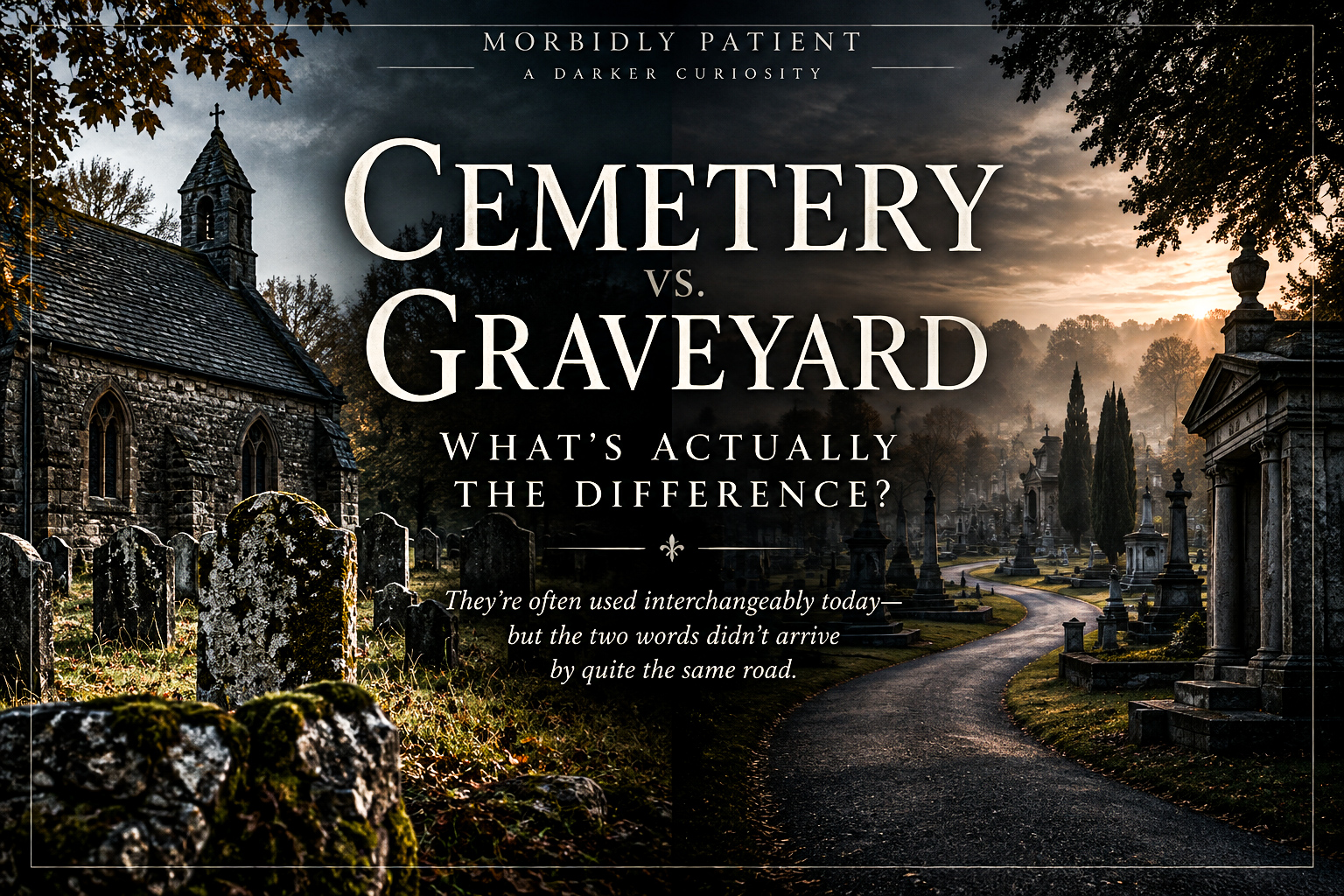
  • Cemetery vs. Graveyard: What’s Actually the Difference?

    Cemetery vs. Graveyard: What’s Actually the Difference?

    They’re often used interchangeably today—but the two words didn’t arrive by quite the same road.

    Most people use cemetery and graveyard to mean exactly the same thing.

    A place where dead people are buried.

    And in ordinary modern conversation, that’s perfectly fine.

    But if you’ve ever wandered through an old burial ground—or spent enough time around people who enjoy wandering through old burial grounds—you’ve probably heard someone insist:

    “Actually, that’s a graveyard, not a cemetery.”

    So is there really a difference?

    Historically, yes.

    But like many things involving language, religion and death, the real story is more interesting than the simple rule you’ll find repeated online.

    The Short Answer

    Traditionally, a graveyard was a burial ground associated with a church, often occupying the churchyard itself.

    A cemetery developed as a broader term for a dedicated burial ground that did not necessarily have any connection to a church.

    That’s the distinction most commonly made today.

    So if you’re standing among old stones surrounding a centuries-old church, graveyard is probably the historically appropriate word.

    If you’re walking through a large municipal, private or garden-style burial ground established independently of a church, cemetery is probably more precise.

    But don’t start correcting strangers just yet.

    The history gets better.


    The Graveyard Came First

    The word graveyard is wonderfully literal.

    A grave is a place where a body is buried.

    A yard is an enclosed or defined piece of ground.

    Put them together and you have exactly what the name suggests:

    a yard containing graves.

    For centuries in Christian Europe, burial was closely connected with the church.

    Churches weren’t merely places people visited once a week. They stood near the center of community life.

    People were baptized there.

    Married there.

    Worshipped there.

    And when they died, many were buried there—or as close to it as circumstances and status permitted.

    The ground surrounding the church became the churchyard.

    And when that ground contained burials, it was naturally also a graveyard.

    This is why some of the oldest graveyards feel so different from modern cemeteries.

    The church is often the visual center.

    The stones seem to have grown around it.

    Generations of the same families may occupy the ground.

    Paths wind awkwardly between monuments because nobody designed the place as one unified landscape.

    It accumulated.

    The dead joined the community of the dead much as they had belonged to the community of the living.


    Then the Cities Got Crowded

    As populations grew and cities expanded, burying generations of people around local churches created increasingly obvious problems.

    There was only so much ground.

    Burial spaces became crowded.

    Existing graves could be disturbed.

    Public-health concerns grew.

    And rapidly expanding urban populations needed somewhere else to put their dead.

    During the eighteenth and especially nineteenth centuries, purpose-built burial grounds increasingly developed outside traditional churchyards.

    This was part of a much larger transformation in how people thought about burial space.

    And we needed a word for these places.

    Cemetery was waiting.


    Cemetery Has a Surprisingly Beautiful Origin

    The English word cemetery ultimately traces back through Latin and Greek to a word associated with a sleeping place or dormitory.

    That’s rather different from graveyard.

    Graveyard describes what is physically there:

    graves in a yard.

    Cemetery carries an old metaphor:

    the dead are sleeping.

    That language makes considerably more sense when viewed through early Christian ideas about death and eventual resurrection. Death could be described as sleep—the body resting while awaiting what came next.

    Over time, cemetery became the standard term for larger dedicated burial grounds, especially those established separately from individual churches.

    By the nineteenth century, some of these places were becoming something entirely new.


    The Cemetery Became a Landscape

    If you’ve ever visited a great nineteenth-century garden cemetery, you’ve seen the difference.

    These weren’t merely fields where graves happened to be located.

    They were deliberately designed.

    Winding paths.

    Trees.

    Gardens.

    Sculpture.

    Mausoleums.

    Elaborate monuments.

    Places for walking and contemplation.

    Before large public parks became common in American cities, some rural cemeteries effectively served as public green spaces. Families could spend an afternoon walking among monuments and landscaped grounds.

    Death wasn’t hidden away behind a fence where nobody went unless somebody had just died.

    The cemetery could become part memorial landscape, part sculpture garden, part historical record, and part public space.

    And that’s one reason old cemeteries remain so fascinating today.

    You’re not simply walking through a place containing bodies.

    You’re walking through architecture, religion, art, social history, family history and changing attitudes toward death—all layered on top of one another.


    So Is a Graveyard Always Beside a Church?

    Here’s where we need to resist making language neater than it actually is.

    You’ll often encounter this rule online:

    Graveyard = attached to a church.
    Cemetery = not attached to a church.

    That’s a useful shorthand.

    It is not an absolute law of the English language.

    The words have overlapped historically, and modern speakers routinely use graveyard for burial grounds without churches and cemetery for burial grounds associated with churches.

    Regional usage matters.

    Local tradition matters.

    The history of a particular property matters.

    And language has an irritating habit of refusing to obey tidy internet graphics.

    So if someone calls the local cemetery a graveyard, you probably don’t need to correct them.

    You’ll survive.

    Eventually, anyway.


    And What About a Burial Ground?

    There’s another term you’ll encounter frequently, particularly at historic sites:

    burial ground or burying ground.

    This can be especially useful because it doesn’t necessarily imply either the traditional churchyard association of graveyard or the later institutional character we often associate with cemetery.

    Historic family burial grounds are a good example.

    So are small community burial places.

    You may also encounter:

    churchyard — the land surrounding a church, which may or may not contain burials.

    memorial park — a term often associated with twentieth-century cemeteries emphasizing landscaped grounds and lower-profile markers.

    potter’s field — traditionally a burial place for people who were poor, unidentified or otherwise buried at public expense.

    necropolis — literally a “city of the dead,” generally used for large or historically significant burial complexes.

    And then there are crypts, mausoleums, columbaria, ossuaries and catacombs.

    We’ll get to those.

    This is Morbidly Patient, after all.

    We have time.


    Which Word Should You Use?

    Here’s the easiest rule.

    If the burial ground is around a church, calling it a graveyard emphasizes that traditional relationship.

    If it’s a purpose-built burial property independent of a church, cemetery is generally the better term.

    If you’re dealing with a historic place and want to be especially accurate, use the name the place uses for itself.

    And if you’re simply telling someone:

    “I spent Saturday morning wandering around an old graveyard taking pictures of dead people’s monuments…”

    Nobody from the International Bureau of Cemetery Terminology is coming to arrest you.

    Probably.


    Why the Difference Matters at All

    The distinction isn’t particularly important because one word is “correct” and the other is “wrong.”

    It’s interesting because the words preserve a change in our relationship with death.

    The graveyard belongs to an older landscape in which the dead remained physically close to the church and community.

    The cemetery reflects the development of dedicated landscapes for the dead—places increasingly separated from ordinary religious and residential space and eventually designed specifically for remembrance, mourning and visitation.

    Two words.

    Two overlapping ideas.

    And centuries of changing attitudes toward where the dead belong.

    That’s the sort of distinction we enjoy around here.

    Not because you need another obscure fact with which to correct your friends.

    But because ordinary words sometimes contain pieces of history we’ve stopped noticing.

    The next time you walk through an old churchyard, look around.

    Notice how close the stones are to the building.

    Notice the generations gathered together.

    Notice how the place grew rather than being perfectly planned.

    Then compare it with a nineteenth- or twentieth-century cemetery designed with roads, sections, landscaping and carefully arranged plots.

    Both places contain the dead.

    But they emerged from slightly different ideas about where the dead should be among the living.

    And once you know what you’re looking at, even the name on the gate begins telling a story.

    Morbidly Patient
    A Darker Curiosity.

    For those curious enough to look where others look away.
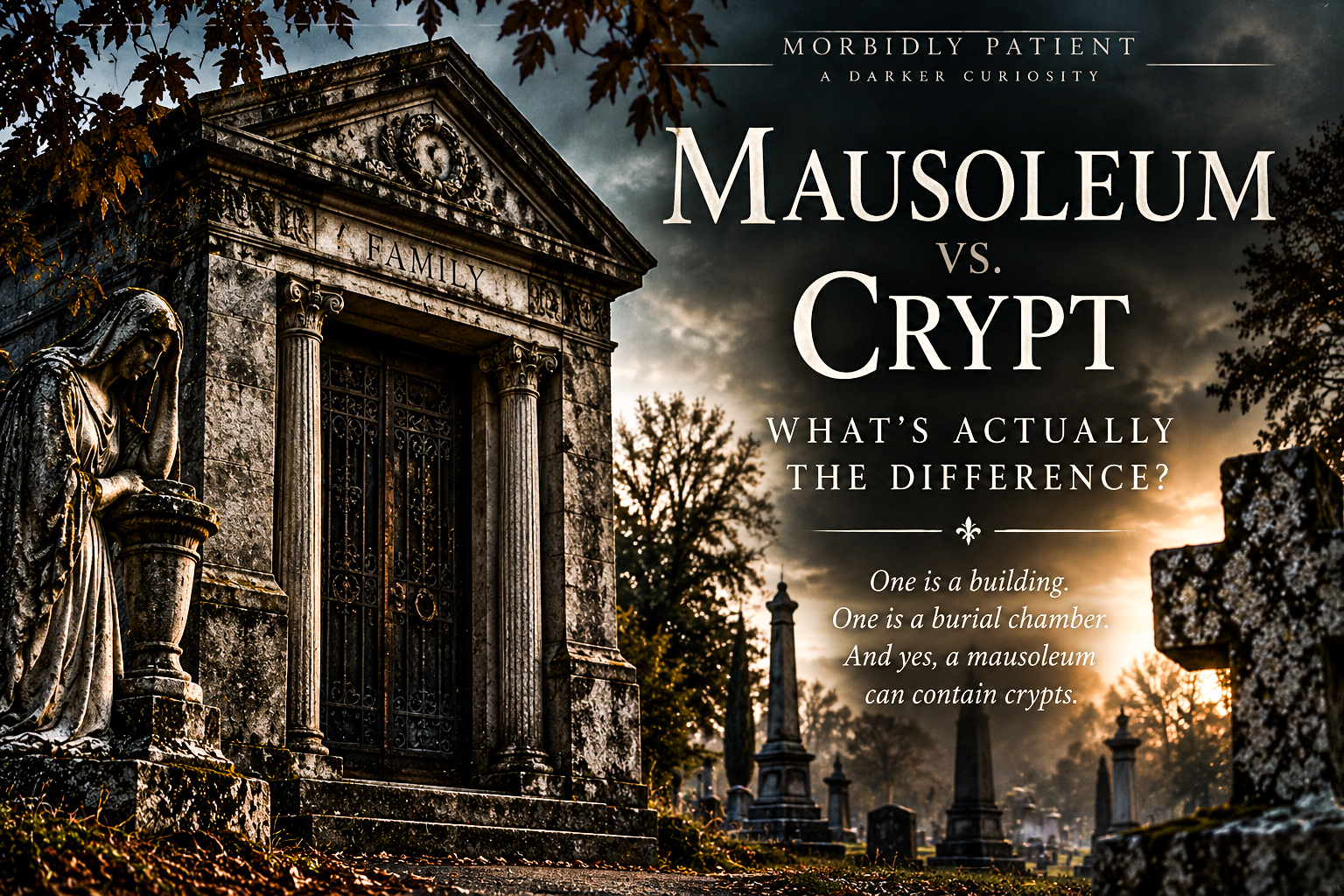
  • Mausoleum vs. Crypt: What’s Actually the Difference?

    Mausoleum vs. Crypt: What’s Actually the Difference?

    One is a building. One is a burial chamber. And yes, a mausoleum can contain crypts.

    Walk through an older cemetery long enough and eventually you’ll encounter one.

    A little stone building sitting among the graves.

    Maybe it has heavy bronze doors.

    Maybe there are stained-glass windows.

    Maybe a family name is carved prominently above the entrance.

    Maybe you can peer through the doors and see something inside.

    And there’s a good chance someone walking beside you will say:

    “That’s a crypt.”

    Maybe.

    But probably not.

    The building itself is usually a mausoleum.

    The crypt is something else.

    The two words are closely related because they often describe parts of the same burial arrangement, but they aren’t interchangeable.

    Fortunately, the difference is considerably easier to understand than some cemetery terminology.

    A mausoleum is a structure.

    A crypt is a chamber or space used to hold human remains.

    And the story behind those two words takes us from one extraordinarily elaborate ancient tomb to churches, cemeteries, underground chambers and the little stone buildings we still construct for our dead.


    The Short Answer

    Let’s make this easy before we wander down the historical rabbit hole.

    A mausoleum is a building or above-ground structure constructed to contain human remains.

    A crypt is an individual burial chamber, compartment or enclosed space where a body or remains are placed.

    Therefore:

    A mausoleum can contain one crypt.

    It can contain several crypts.

    A large community mausoleum can contain hundreds or even thousands of them.

    But a crypt doesn’t necessarily have to be inside what we’d normally call a mausoleum.

    Crypts can also exist beneath churches and other structures.

    Think of it this way:

    The mausoleum is the structure.

    The crypt is where the dead person actually goes.

    Now that we’ve solved the practical problem, naturally we’re going to make things more interesting.


    Mausoleum: A Man Became a Word

    Unlike graveyard, which is about as literal as words get, mausoleum has a much better origin story.

    It comes from a person’s name.

    Mausolus.

    Mausolus was a ruler of Caria in the fourth century BCE in what is now southwestern Turkey.

    After his death around 353 BCE, an enormous monumental tomb was constructed for him at Halicarnassus.

    Calling it a tomb almost undersells the thing.

    The Mausoleum at Halicarnassus became one of the Seven Wonders of the Ancient World.

    Ancient descriptions and archaeological evidence indicate an enormous elevated structure decorated with extensive sculpture and crowned by a stepped roof and sculptural elements.

    It was intended to do considerably more than simply keep Mausolus’ remains out of the rain.

    It was architecture saying:

    This person mattered.

    And apparently it worked.

    Most of us couldn’t tell you much about Mausolus.

    But more than two thousand years later, we still use a version of his name every time we call a monumental burial structure a mausoleum.

    That’s a fairly impressive afterlife for a name.

    Eventually mausoleum stopped referring only to the Mausoleum and became a general term for monumental structures containing tombs or burial chambers.

    Which brings us back to those little stone buildings in our cemeteries.


    So What’s Inside a Mausoleum?

    That depends on the mausoleum.

    Some are built for a single person.

    Others hold a married couple.

    Some contain generations of one family.

    Large community mausoleums may contain the remains of hundreds or thousands of unrelated people.

    Inside you’ll generally find spaces designed to receive the dead.

    Those spaces are crypts.

    A casket may be placed into a crypt, which is then sealed and usually faced with stone, marble, granite or another material.

    The front may carry much the same information we’d expect to find on a headstone:

    A name.

    Birth date.

    Death date.

    An inscription.

    Religious imagery.

    Sometimes photographs or decorative elements.

    The fundamental idea isn’t terribly different from burial in the ground.

    We’ve simply changed the architecture.

    Instead of:

    body → casket → grave → earth

    we have something more like:

    body → casket → crypt → mausoleum

    One puts the dead beneath the landscape.

    The other incorporates them into a structure.


    But Crypts Can Be Underground

    This is where the terminology becomes more interesting.

    Say the word crypt and many of us immediately imagine something beneath an ancient church.

    Stone stairs descending into darkness.

    Arched ceilings.

    Dust.

    Candles.

    Perhaps a skeleton for atmosphere.

    And historically, that association makes sense.

    The word ultimately comes from Greek language associated with something hidden or concealed.

    Crypts developed particularly strong associations with chambers beneath churches.

    Early Christian churches sometimes incorporated spaces associated with saints, martyrs, relics or burials beneath or near important areas of the building.

    Over time, underground church crypts became burial places for clergy, nobles and other significant individuals in various places.

    So:

    A crypt does not have to be inside a freestanding mausoleum.

    It may be underneath a church.

    It may be incorporated into another building.

    It may even be part of a structure largely below ground.

    The defining feature isn’t really whether you can see it from outside.

    It’s the burial chamber itself.


    Then What’s a Tomb?

    Now we’ve opened another door.

    A tomb is the broader term.

    A tomb is a structure, chamber or enclosed place containing human remains.

    That means both mausoleums and crypts can fall within the larger world of tombs.

    The pyramids?

    Tombs.

    Elaborate rock-cut burial chambers?

    Tombs.

    A sarcophagus inside a monumental structure?

    Part of a tomb arrangement.

    The word is broad enough that trying to make every burial structure fit into one perfectly clean taxonomy becomes difficult very quickly.

    Humans have been constructing places for dead people for thousands of years.

    We were not thinking about whether twenty-first-century cemetery enthusiasts would find our terminology convenient.

    Inconsiderate, really.


    And What About a Sarcophagus?

    A sarcophagus is different again.

    It’s essentially a stone coffin or coffin-like container.

    The word has a particularly wonderful—and slightly horrifying—history.

    It comes through Greek and Latin from words associated with “flesh-eating” stone.

    Certain limestone was believed to help consume or decompose the flesh of bodies placed within it.

    Hence:

    sarko — flesh

    phagein — to eat

    A flesh eater.

    Language is occasionally delightful.

    A sarcophagus can be placed inside a tomb.

    A tomb can be inside a mausoleum.

    And a mausoleum can contain crypts.

    Which means you can potentially encounter several correct burial terms while standing in front of one structure.

    Welcome to cemetery terminology.


    Private Mausoleums vs. Community Mausoleums

    Most of the picturesque structures photographers gravitate toward are private mausoleums.

    These were often constructed for wealthy individuals or families.

    Family names may be carved prominently across the façade.

    Architectural styles vary tremendously.

    Classical columns.

    Gothic arches.

    Egyptian Revival motifs.

    Romanesque stonework.

    Art Deco.

    Stained glass.

    Bronze doors.

    Religious sculpture.

    Sometimes the architecture tells you nearly as much about the period and family as the inscriptions do.

    But mausoleums aren’t exclusively private monuments.

    Community mausoleums contain crypts for many individuals or families within one larger building.

    Some modern cemeteries have enormous indoor mausoleum complexes with corridors lined by crypt fronts.

    There are also garden or outdoor mausoleum arrangements, where crypts are accessed from exterior walls rather than interior hallways.

    Same basic concept.

    Different architecture.


    Mausoleums Tell Us Something About the Living

    This is where cemetery terminology becomes more than vocabulary.

    Why build a house for a dead person?

    Practically speaking, there are reasons.

    Land conditions.

    Family preferences.

    Religious traditions.

    Available cemetery space.

    The desire to keep family members together.

    But throughout history, mausoleums have also communicated something else.

    Status.

    Walk through an old cemetery and architecture becomes social history.

    A small unmarked stone tells one story.

    A modest family plot tells another.

    A towering granite monument tells another.

    And a private stone building with bronze doors and stained glass makes a statement difficult to miss.

    Someone had the resources to build this.

    Someone wanted permanence.

    Someone expected the family name to remain visible.

    And perhaps someone couldn’t tolerate the thought of the person simply disappearing beneath the ground.

    There’s something wonderfully human about that.

    We know stone eventually fails.

    Names weather away.

    Families die out.

    Buildings collapse.

    Even the Mausoleum at Halicarnassus didn’t survive intact.

    And yet we build.

    We carve.

    We seal names into granite.

    We construct little houses for people who no longer need shelter.

    Perhaps that’s part of what cemeteries really are.

    Architecture built against forgetting.


    So, Mausoleum or Crypt?

    The next time you’re wandering through a cemetery and encounter one of those stone structures, here’s your simple field guide:

    MAUSOLEUM
    The building or above-ground burial structure.

    CRYPT
    The chamber or compartment where human remains are placed.

    TOMB
    A broader term for a structure or enclosed place containing the dead.

    SARCOPHAGUS
    A stone coffin or coffin-like container for human remains.

    And if you want one sentence to remember everything:

    You can put a sarcophagus in a tomb, crypts inside a mausoleum, and a mausoleum itself is a type of monumental tomb.

    Cemetery vocabulary solved.

    Mostly.

    Because we haven’t even gotten to columbaria, ossuaries, catacombs, cenotaphs, vaults and niches yet.

    We will.

    We’re Morbidly Patient.

    There are plenty of dead words left to dig up.

    Morbidly Patient
    A Darker Curiosity.

    For those curious enough to look where others look away.
  • What Is a Taphophile?

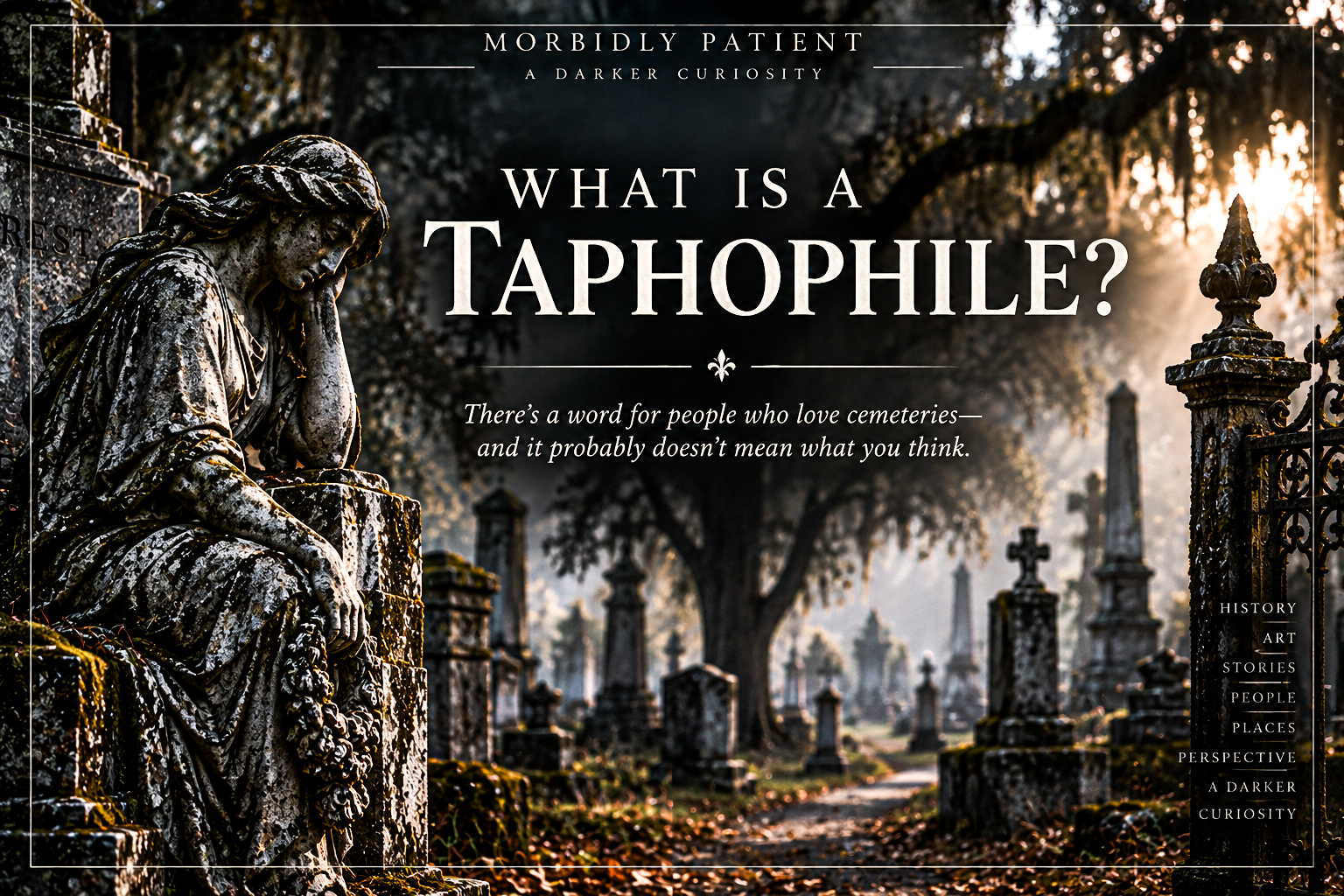
    What Is a Taphophile?

    There’s a word for people who love cemeteries—and it probably doesn’t mean what you think.

    Maybe you’ve always done it.

    You’re driving somewhere when you pass an old cemetery.

    Not one of the perfectly manicured modern ones.

    An old one.

    Crooked stones.

    Large trees.

    Maybe an iron fence.

    A few monuments leaning at angles they definitely weren’t installed at.

    And almost automatically you look over and think:

    I wonder what’s in there.

    Not in a paranormal-investigation sort of way.

    You aren’t necessarily expecting ghosts.

    You’re wondering how old the cemetery is.

    Who is buried there.

    Whether there are interesting monuments.

    What the oldest stone says.

    Whether there are symbols you’ve never seen before.

    Maybe you want to photograph it.

    Maybe you want to walk among the graves and read names belonging to people who haven’t heard their names spoken aloud in a century.

    Maybe your traveling companion sees absolutely nothing unusual about your suggestion:

    “We’ve got twenty minutes. Want to walk through that cemetery?”

    Or maybe they look at you like you’ve just proposed spending the afternoon at the county morgue.

    If any of this sounds familiar, there’s a word you may want to know.

    Taphophile.

    And despite how ominous it sounds, it doesn’t mean someone who wants to do anything disturbing with dead bodies.

    It basically means:

    You really like cemeteries.

    Welcome to the club.


    What Does Taphophile Mean?

    A taphophile is someone with a strong interest in cemeteries, graves, tombstones, funerary monuments and related subjects.

    The word combines Greek roots associated with tomb or burial and love or affinity.

    Essentially:

    a lover of graves.

    That sounds considerably more sinister than the reality usually is.

    Taphophiles may be interested in:

    Cemetery history.

    Genealogy.

    Gravestone symbolism.

    Funerary art.

    Architecture.

    Photography.

    Epitaphs.

    Local history.

    Stone carving.

    Historic preservation.

    Burial customs.

    Or simply the experience of wandering through old cemeteries.

    There’s no membership card.

    No initiation ritual.

    No required black wardrobe.

    And you aren’t required to own a raven.

    Although admittedly, a raven would improve the aesthetic considerably.


    Isn’t That a Little Morbid?

    Yes.

    That’s sort of the point.

    But morbid doesn’t necessarily mean unhealthy, miserable or obsessed with death.

    The word has accumulated plenty of negative baggage, but curiosity about death is one of the most persistent features of human culture.

    We’ve built pyramids for dead people.

    Written books about death.

    Painted it.

    Photographed it.

    Created elaborate funeral rituals.

    Preserved bodies.

    Carved monuments.

    Written poems for the dead.

    Built entire cities devoted to housing their remains.

    Humans are a death-curious species.

    Some of us are simply less interested in pretending otherwise.

    And cemeteries happen to be extraordinary places for exploring that curiosity.


    Cemeteries Are Outdoor Museums

    This is one reason I think people misunderstand taphophiles.

    If you’ve never learned to read a cemetery, you may see:

    rows of tombstones.

    Once you begin paying attention, you see considerably more.

    A cemetery can be an outdoor museum containing sculpture, architecture, typography, religion, social history, genealogy, craftsmanship, botany and folklore.

    A broken column may tell you something.

    So can clasped hands.

    An anchor.

    A lamb.

    An urn.

    A willow tree.

    A finger pointing upward.

    A particular flower.

    Symbols belonging to fraternal organizations.

    Military insignia.

    Occupational imagery.

    Even the material used to make a monument can help place it within a particular period.

    Then there are the inscriptions.

    Some are painfully simple.

    Some are beautiful.

    Some are unintentionally funny.

    Some tell you almost nothing.

    Others give you enough information to send you down a historical rabbit hole for the next three hours.

    A cemetery isn’t merely where history is buried.

    Sometimes it’s where history is still visible.

    You just have to learn how to look.


    Every Stone Is a Tiny Biography

    Here’s something else that happens when you spend enough time in cemeteries.

    The stones stop being scenery.

    You start reading them.

    Elizabeth Morgan
    1847–1903

    That’s almost nothing.

    A name.

    Two dates.

    Fifty-six years reduced to a few inches of carved stone.

    But then your brain starts doing something troublesome.

    Who was Elizabeth?

    What did she sound like?

    Did she have children?

    What did she worry about?

    What did she think the future would look like?

    Did she ever imagine a stranger would stand above her grave more than a century later wondering about her?

    Sometimes another stone nearby gives you part of the answer.

    Her husband.

    A child.

    Her parents.

    Maybe several children who died unusually close together.

    Suddenly the cemetery isn’t a collection of objects anymore.

    It’s a collection of interrupted stories.

    And perhaps that’s part of what draws some taphophiles back.

    The stones remind us that history wasn’t populated by historical characters.

    It was populated by people.

    People who were once every bit as alive and ordinary as we are.


    Why Do People Photograph Cemeteries?

    Photography and taphophilia naturally find one another.

    It’s easy to understand why.

    Cemeteries are visually extraordinary.

    Weathered marble.

    Lichen.

    Moss.

    Iron fences.

    Sculpture.

    Symmetry.

    Decay.

    Old trees.

    Changing light.

    Fog.

    Architecture.

    The contrast between objects intended to be permanent and nature slowly demonstrating that nothing actually is.

    But cemetery photography can also preserve something.

    Gravestones deteriorate.

    Marble inscriptions disappear.

    Markers are damaged.

    Trees fall.

    Cemeteries are vandalized.

    Family burial grounds become overgrown.

    Development encroaches.

    Sometimes a photograph taken casually twenty years ago becomes a historical record of something that no longer exists in the same condition.

    The photograph becomes another kind of memorial.

    A record of a record.


    Do Taphophiles Believe in Ghosts?

    Some do.

    Some don’t.

    The two interests overlap, but they aren’t the same thing.

    You can be fascinated by cemeteries without believing they’re inhabited by anything except squirrels, insects, birds and the occasional irritated groundskeeper.

    You can also be deeply interested in ghosts, paranormal folklore and supernatural traditions.

    Neither is a requirement.

    That’s important around here.

    We don’t need to manufacture supernatural stories to make cemeteries interesting.

    The documented history is usually strange enough.

    If there’s a ghost story associated with a place, we’ll happily explore the folklore.

    But folklore and evidence aren’t necessarily the same thing.

    “I don’t know” remains a perfectly acceptable answer.


    There Is an Etiquette to This

    Being interested in cemeteries doesn’t mean treating them like amusement parks.

    They’re historical spaces.

    They’re also places where people have buried people they loved.

    Sometimes very recently.

    So wandering cemeteries comes with a few basic expectations.

    Respect posted hours and rules.

    Don’t climb on monuments.

    Don’t move objects.

    Don’t take souvenirs.

    Don’t disturb flowers, coins or other items left at graves.

    Be particularly considerate around active funerals and grieving visitors.

    Be thoughtful when photographing identifiable people visiting graves.

    And if a cemetery prohibits photography, respect that.

    Most of this shouldn’t require a rulebook.

    The simplest guideline is:

    Be curious without becoming intrusive.

    The dead may not care what you’re doing.

    The living sometimes do.


    Maybe You’ve Been a Taphophile for Years

    That’s the funny thing about discovering the word.

    You may have had the interest long before you knew anyone had bothered naming it.

    Maybe you photograph old stones.

    Maybe you search for forgotten family cemeteries.

    Maybe you study funerary symbols.

    Maybe you read epitaphs.

    Maybe you enjoy the silence.

    Maybe you’re interested in the art.

    Maybe walking through a cemetery makes mortality feel a little less abstract.

    Or maybe you’re simply incapable of passing an old iron cemetery gate without wondering what’s on the other side.

    You don’t need to justify it.

    You don’t have to make it spooky.

    And you certainly don’t have to believe anything in particular about what happens to the people underneath those stones.

    Curiosity is enough.

    In fact, that’s largely what Morbidly Patient is built around.

    Not an obsession with dying.

    A curiosity about the enormous collection of things human beings have created because we know that we do.

    Cemeteries just happen to be one of the best places to see it.

    So the next time somebody asks why you want to spend a perfectly pleasant Saturday afternoon wandering among dead people, you have options.

    You could explain the history.

    The sculpture.

    The genealogy.

    The photography.

    The architecture.

    The symbolism.

    The preservation.

    Or you could save yourself a considerable amount of time.

    Tell them:

    “I’m a taphophile.”

    Then walk away without explaining what it means.

    Sometimes a little mystery is good for people.

    Morbidly Patient
    A Darker Curiosity.

    For those curious enough to look where others look away.