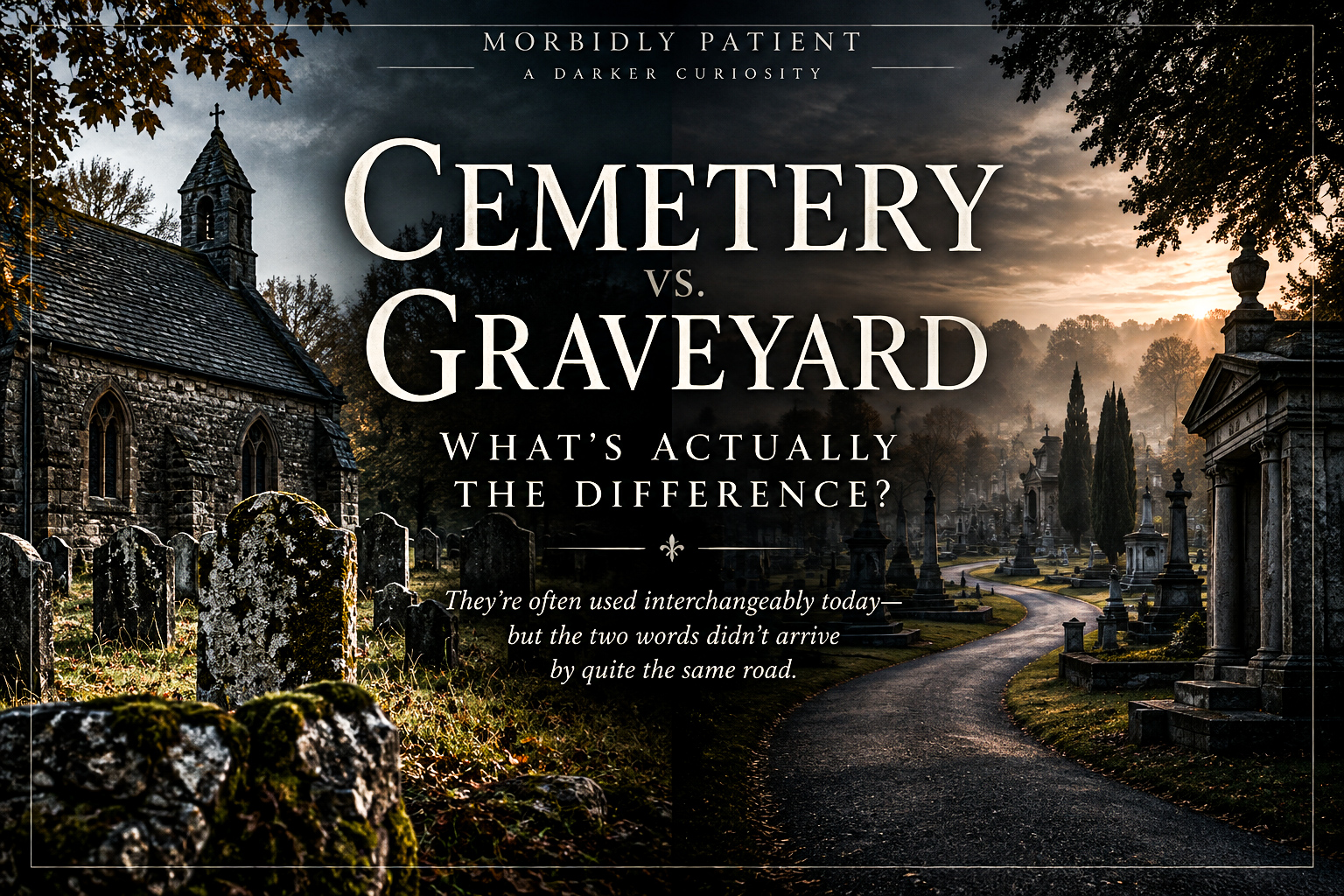
They’re often used interchangeably today—but the two words didn’t arrive by quite the same road.
Most people use cemetery and graveyard to mean exactly the same thing.
A place where dead people are buried.
And in ordinary modern conversation, that’s perfectly fine.
But if you’ve ever wandered through an old burial ground—or spent enough time around people who enjoy wandering through old burial grounds—you’ve probably heard someone insist:
“Actually, that’s a graveyard, not a cemetery.”
So is there really a difference?
Historically, yes.
But like many things involving language, religion and death, the real story is more interesting than the simple rule you’ll find repeated online.
The Short Answer
Traditionally, a graveyard was a burial ground associated with a church, often occupying the churchyard itself.
A cemetery developed as a broader term for a dedicated burial ground that did not necessarily have any connection to a church.
That’s the distinction most commonly made today.
So if you’re standing among old stones surrounding a centuries-old church, graveyard is probably the historically appropriate word.
If you’re walking through a large municipal, private or garden-style burial ground established independently of a church, cemetery is probably more precise.
But don’t start correcting strangers just yet.
The history gets better.
The Graveyard Came First
The word graveyard is wonderfully literal.
A grave is a place where a body is buried.
A yard is an enclosed or defined piece of ground.
Put them together and you have exactly what the name suggests:
a yard containing graves.
For centuries in Christian Europe, burial was closely connected with the church.
Churches weren’t merely places people visited once a week. They stood near the center of community life.
People were baptized there.
Married there.
Worshipped there.
And when they died, many were buried there—or as close to it as circumstances and status permitted.
The ground surrounding the church became the churchyard.
And when that ground contained burials, it was naturally also a graveyard.
This is why some of the oldest graveyards feel so different from modern cemeteries.
The church is often the visual center.
The stones seem to have grown around it.
Generations of the same families may occupy the ground.
Paths wind awkwardly between monuments because nobody designed the place as one unified landscape.
It accumulated.
The dead joined the community of the dead much as they had belonged to the community of the living.
Then the Cities Got Crowded
As populations grew and cities expanded, burying generations of people around local churches created increasingly obvious problems.
There was only so much ground.
Burial spaces became crowded.
Existing graves could be disturbed.
Public-health concerns grew.
And rapidly expanding urban populations needed somewhere else to put their dead.
During the eighteenth and especially nineteenth centuries, purpose-built burial grounds increasingly developed outside traditional churchyards.
This was part of a much larger transformation in how people thought about burial space.
And we needed a word for these places.
Cemetery was waiting.
Cemetery Has a Surprisingly Beautiful Origin
The English word cemetery ultimately traces back through Latin and Greek to a word associated with a sleeping place or dormitory.
That’s rather different from graveyard.
Graveyard describes what is physically there:
graves in a yard.
Cemetery carries an old metaphor:
the dead are sleeping.
That language makes considerably more sense when viewed through early Christian ideas about death and eventual resurrection. Death could be described as sleep—the body resting while awaiting what came next.
Over time, cemetery became the standard term for larger dedicated burial grounds, especially those established separately from individual churches.
By the nineteenth century, some of these places were becoming something entirely new.
The Cemetery Became a Landscape
If you’ve ever visited a great nineteenth-century garden cemetery, you’ve seen the difference.
These weren’t merely fields where graves happened to be located.
They were deliberately designed.
Winding paths.
Trees.
Gardens.
Sculpture.
Mausoleums.
Elaborate monuments.
Places for walking and contemplation.
Before large public parks became common in American cities, some rural cemeteries effectively served as public green spaces. Families could spend an afternoon walking among monuments and landscaped grounds.
Death wasn’t hidden away behind a fence where nobody went unless somebody had just died.
The cemetery could become part memorial landscape, part sculpture garden, part historical record, and part public space.
And that’s one reason old cemeteries remain so fascinating today.
You’re not simply walking through a place containing bodies.
You’re walking through architecture, religion, art, social history, family history and changing attitudes toward death—all layered on top of one another.
So Is a Graveyard Always Beside a Church?
Here’s where we need to resist making language neater than it actually is.
You’ll often encounter this rule online:
Graveyard = attached to a church.
Cemetery = not attached to a church.
That’s a useful shorthand.
It is not an absolute law of the English language.
The words have overlapped historically, and modern speakers routinely use graveyard for burial grounds without churches and cemetery for burial grounds associated with churches.
Regional usage matters.
Local tradition matters.
The history of a particular property matters.
And language has an irritating habit of refusing to obey tidy internet graphics.
So if someone calls the local cemetery a graveyard, you probably don’t need to correct them.
You’ll survive.
Eventually, anyway.
And What About a Burial Ground?
There’s another term you’ll encounter frequently, particularly at historic sites:
burial ground or burying ground.
This can be especially useful because it doesn’t necessarily imply either the traditional churchyard association of graveyard or the later institutional character we often associate with cemetery.
Historic family burial grounds are a good example.
So are small community burial places.
You may also encounter:
churchyard — the land surrounding a church, which may or may not contain burials.
memorial park — a term often associated with twentieth-century cemeteries emphasizing landscaped grounds and lower-profile markers.
potter’s field — traditionally a burial place for people who were poor, unidentified or otherwise buried at public expense.
necropolis — literally a “city of the dead,” generally used for large or historically significant burial complexes.
And then there are crypts, mausoleums, columbaria, ossuaries and catacombs.
We’ll get to those.
This is Morbidly Patient, after all.
We have time.
Which Word Should You Use?
Here’s the easiest rule.
If the burial ground is around a church, calling it a graveyard emphasizes that traditional relationship.
If it’s a purpose-built burial property independent of a church, cemetery is generally the better term.
If you’re dealing with a historic place and want to be especially accurate, use the name the place uses for itself.
And if you’re simply telling someone:
“I spent Saturday morning wandering around an old graveyard taking pictures of dead people’s monuments…”
Nobody from the International Bureau of Cemetery Terminology is coming to arrest you.
Probably.
Why the Difference Matters at All
The distinction isn’t particularly important because one word is “correct” and the other is “wrong.”
It’s interesting because the words preserve a change in our relationship with death.
The graveyard belongs to an older landscape in which the dead remained physically close to the church and community.
The cemetery reflects the development of dedicated landscapes for the dead—places increasingly separated from ordinary religious and residential space and eventually designed specifically for remembrance, mourning and visitation.
Two words.
Two overlapping ideas.
And centuries of changing attitudes toward where the dead belong.
That’s the sort of distinction we enjoy around here.
Not because you need another obscure fact with which to correct your friends.
But because ordinary words sometimes contain pieces of history we’ve stopped noticing.
The next time you walk through an old churchyard, look around.
Notice how close the stones are to the building.
Notice the generations gathered together.
Notice how the place grew rather than being perfectly planned.
Then compare it with a nineteenth- or twentieth-century cemetery designed with roads, sections, landscaping and carefully arranged plots.
Both places contain the dead.
But they emerged from slightly different ideas about where the dead should be among the living.
And once you know what you’re looking at, even the name on the gate begins telling a story.
Morbidly Patient
A Darker Curiosity.
For those curious enough to look where others look away.
Leave a Reply