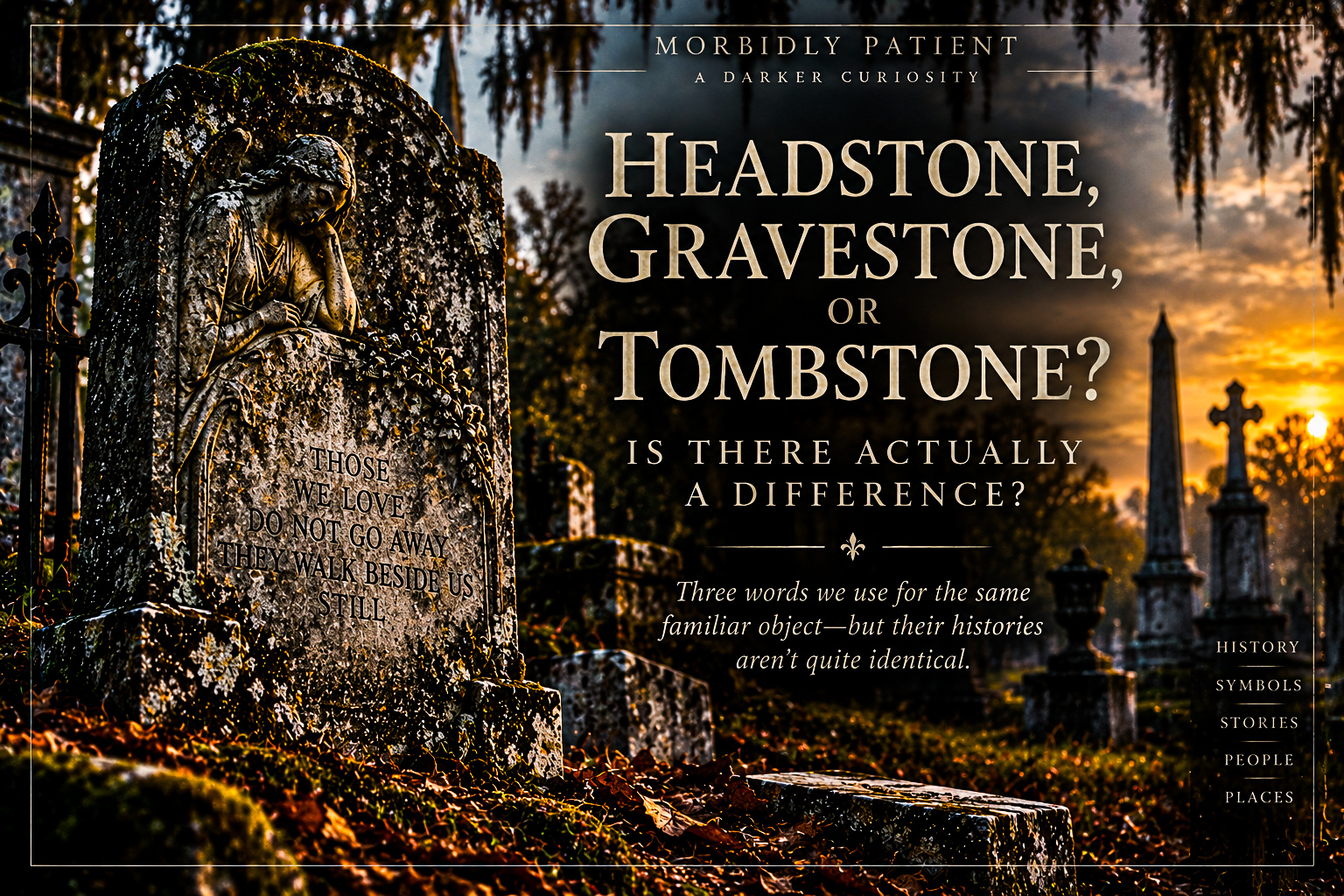
Three words we use for the same familiar object, but their histories aren’t quite identical.
You’re walking through an old cemetery when you find a stone that makes you stop.
Maybe it’s leaning slightly to one side.
Maybe moss has crept across the inscription.
Maybe the name is still perfectly readable while the dates beneath it have almost disappeared.
You take a photograph.
And later, when you’re writing the caption, you encounter an unexpectedly difficult question:
What exactly do you call the thing?
A headstone?
A gravestone?
A tombstone?
Surely there must be a rule.
After all, the internet loves rules.
You’ll find explanations confidently informing you that a headstone goes at the head, a footstone goes at the feet, a gravestone covers a grave, and a tombstone originally sealed a tomb.
Some of that has historical reasoning behind it.
Some of it is language being tidied up after the fact.
Because in modern English, headstone, gravestone, and tombstone are largely interchangeable.
But they didn’t all take exactly the same path to get here.
And those paths tell us something interesting about how we have marked our dead.
The Short Answer
If you’re talking about the upright stone marker carrying someone’s name, dates, and perhaps an epitaph, you can usually call it a:
headstone
gravestone
or
tombstone
…and people will know exactly what you mean.
In contemporary usage, headstone and gravestone are particularly straightforward terms for a marker placed at a grave.
Tombstone is also widely used that way.
There isn’t a Cemetery Vocabulary Enforcement Division waiting behind the mausoleum to issue citations.
But historically, the words developed from somewhat different ideas.
So let’s dig them up.
What Is a Headstone?
This one seems obvious.
A headstone is a stone placed at the head of a grave.
And historically, that’s essentially where the term comes from.
In some burial traditions, a grave could be marked at both ends.
The larger marker at the head was the headstone.
A smaller marker at the opposite end could be the footstone.
You can still find this arrangement in older cemeteries.
Sometimes the footstone carries initials.
Sometimes it contains little information at all.
Sometimes it’s simply there to mark the physical boundary of the grave.
That creates something we’re prone to forgetting when wandering through cemeteries today:
A grave marker wasn’t always merely a commemorative sign.
It could also help tell you where the grave actually was.
The headstone marked one end.
The footstone marked the other.
The body rested between them.
Once you recognize that arrangement, some older cemetery landscapes suddenly make considerably more sense.
What Is a Gravestone?
Gravestone is perhaps the most wonderfully uncomplicated of the three.
It’s a stone associated with a grave.
That’s about it.
A grave, of course, is the place excavated or otherwise prepared for burial.
A gravestone marks that place.
The term doesn’t inherently require the marker to stand precisely at the deceased’s head.
It describes the relationship between the marker and the grave.
This makes gravestone a particularly useful general term when discussing historic burial markers.
But then we have the word that has probably accumulated the most atmosphere.
Tombstone.
What Is a Tombstone?
Today, say tombstone and most people picture exactly what you’d expect.
An upright slab of stone.
A name.
Two dates.
Maybe:
R.I.P.
Popular culture has made the tombstone almost shorthand for death itself.
Cartoons use them.
Halloween decorations use them.
Horror movies use them.
You can buy little foam ones and stick them in your front yard every October.
Which would probably confuse the person whose grave was marked by the original thing.
Historically, however, tomb has a broader meaning than grave.
A grave generally refers to the place of burial, particularly one excavated in the earth.
A tomb can refer to a structure or chamber containing the dead.
And historically, tombstone could be associated with stonework connected with a tomb rather than exclusively the upright cemetery marker we picture today.
Over time, however, the distinctions blurred.
Language does that.
People began using tombstone broadly for grave markers, and eventually the image became so culturally familiar that nobody needs clarification when you use the word.
Then What Is a Grave Marker?
Here’s the term that solves nearly everything.
Grave marker.
A grave marker is any object intended to identify or mark a grave.
That includes many things that aren’t traditional upright stones.
Flat markers.
Bronze plaques.
Simple fieldstones.
Wooden markers.
Crosses.
Government-issued military markers.
Ledger stones.
Temporary funeral-home markers.
And many other forms humans have used to say:
Someone is buried here.
So while headstone, gravestone, and tombstone tend to make us picture stone, grave marker is the broader category.
Not every grave marker is a headstone.
But a headstone is a type of grave marker.
What About Those Flat Stones on the Ground?
Now we’re getting into the terminology I particularly enjoy.
Because cemetery markers come in far more varieties than the familiar upright slab.
A flat marker or flush marker lies approximately level with the ground.
A bevel marker rises slightly above ground level and has a sloping face.
A slant marker sits above ground with an angled inscription surface.
An upright monument is the familiar vertical form.
A ledger stone is a large slab that covers much or most of the grave itself.
And then you encounter obelisks, columns, crosses, statues, pedestal monuments, table tombs and increasingly elaborate structures that make the word headstone feel almost comically inadequate.
Walk through a large nineteenth-century cemetery and you aren’t merely looking at rocks with names written on them.
You’re walking through generations of changing design.
And That Design Wasn’t Random
A grave marker does several jobs simultaneously.
The most obvious is identification.
This person is here.
But humans are rarely satisfied with that.
So we add:
Who they were.
When they lived.
Whom they loved.
What they believed.
What organizations they belonged to.
What military service they performed.
Sometimes what occupation they held.
Then we decorate the marker with symbols.
Hands.
Flowers.
Angels.
Lambs.
Books.
Crosses.
Anchors.
Urns.
Columns.
Trees.
Fraternal emblems.
Military insignia.
And suddenly a piece of stone isn’t simply marking the location of a corpse.
It’s communicating.
That’s why old cemetery markers are so fascinating.
They’re tiny pieces of public biography.
Sometimes the Stone Tells You More Than the Words
Imagine two markers.
One says:
JOHN SMITH
1842–1907
The other gives the same name and dates.
But it’s a towering obelisk surrounded by an iron fence, carved from expensive stone, accompanied by several family graves and decorated with elaborate symbolism.
Technically, both communicate the same basic information.
John Smith lived.
John Smith died.
John Smith is buried here.
But visually?
They’re telling very different stories.
Wealth.
Status.
Family structure.
Religion.
Fashion.
Available materials.
Local craftsmanship.
Even changing attitudes toward mourning.
This is one reason cemetery photography becomes addictive once you begin paying attention.
You’re not merely photographing stones.
You’re photographing decisions made by the living about how the dead should be remembered.
The Problem With Permanence
There’s also a quiet irony in all of this.
We carve names into stone because stone feels permanent.
And then you spend enough time in old cemeteries and discover that it isn’t.
Marble softens.
Letters disappear.
Sandstone crumbles.
Markers crack.
Trees fall.
Ground shifts.
Lichen spreads.
Iron rusts.
Entire family burial grounds vanish beneath vegetation.
Eventually you find stones where you can still see that something was written there, but no longer determine what it said.
Someone once paid to have a person’s name carved permanently into stone.
And time erased it anyway.
That’s difficult not to think about while standing there.
Perhaps that’s part of the appeal of photographing these places.
The photograph preserves the stone.
The stone preserves the name.
The name preserves some tiny fragment of the person.
Each layer attempting to hold onto the one beneath it.
None permanently.
But perhaps permanence was never really available.
Maybe remembrance is something we keep doing precisely because forgetting is inevitable.
So Which Word Should You Use?
If you want a simple answer:
Headstone — traditionally a marker positioned at the head of a grave; now commonly used for an upright grave marker.
Gravestone — a stone used to mark a grave; an excellent general term.
Tombstone — historically connected with tombs and stone memorials, but now commonly used interchangeably with headstone and gravestone.
Grave marker — the broadest and safest term for an object identifying or marking a grave.
And if someone tells you that you’ve committed an unforgivable linguistic offense by calling a gravestone a tombstone?
Smile politely.
You’ve both understood exactly what object was being discussed.
Language has already done its job.
The Stone Isn’t the Important Part
That’s probably the thing worth remembering.
Whether we call it a headstone, gravestone, tombstone, monument, or marker, the object exists because somebody once faced the same problem humans have been confronting for thousands of years:
How do we mark the fact that someone was here?
We put their name somewhere.
We add dates.
Sometimes a few words.
Sometimes an angel.
Sometimes nothing more than a rough stone.
And then we leave it behind for people who may never have known them.
Years pass.
Then decades.
Then centuries.
Eventually a stranger walks through the cemetery, notices the stone, brushes away a leaf, and reads the name.
For a few seconds, someone long dead occupies the thoughts of someone still living.
Maybe that’s all a gravestone was ever really supposed to accomplish.
Whatever you decide to call it.
Morbidly Patient
A Darker Curiosity.
For those curious enough to look where others look away.
Leave a Reply